
Wave Rider Buoy (WRB)
Measuring Waves for Safe Marine Operations
Introduction
The sea is always changing. Wave height, wave direction, and wave period can change throughout the day because of wind, weather, and tides.
Before offshore construction, dredging, port development, or marine research begins, engineers need accurate information about sea conditions.
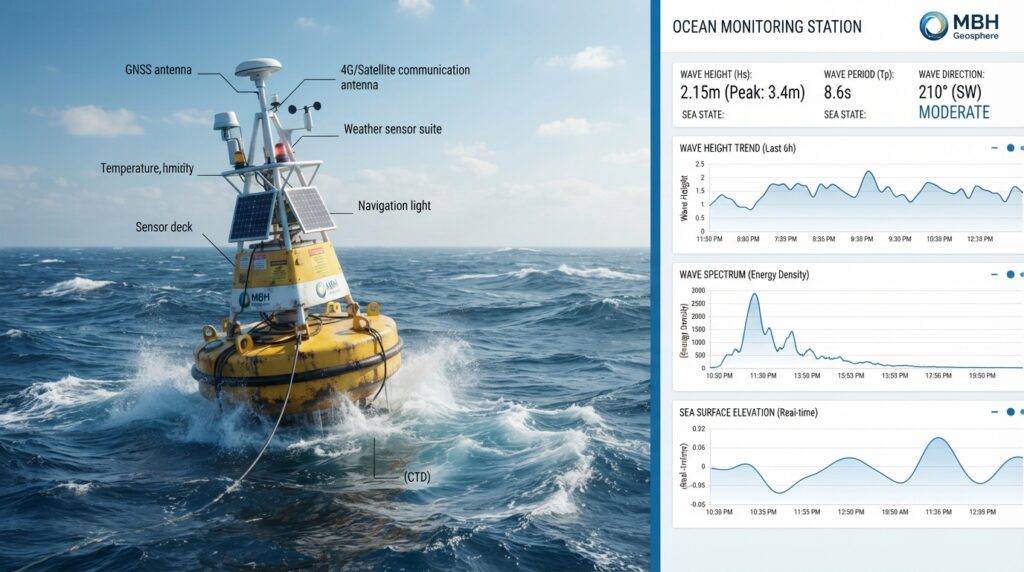
A Wave Rider Buoy (WRB) is a floating ocean monitoring system that measures wave activity and other important environmental data. It provides real-time information that helps engineers, scientists, and marine operators make safe and informed decisions.
Wave Rider Buoys are widely used in hydrographic surveys, offshore oil and gas projects, offshore wind farms, coastal engineering, weather forecasting, and scientific research.
What is a Wave Rider Buoy?
A Wave Rider Buoy is a floating instrument designed to measure the movement of ocean waves.
As the buoy moves with the waves, built-in sensors record information such as wave height, wave period, and wave direction.
The collected data is stored inside the buoy and can also be transmitted to a monitoring station in real time using satellite or radio communication.
This information helps engineers understand sea conditions before and during marine operations.
Why is a Wave Rider Buoy Important?
Marine projects depend on safe sea conditions.
If wave conditions are unknown, offshore work can become dangerous and expensive.
A Wave Rider Buoy helps engineers answer important questions such as:
How high are the waves?
What is the wave direction?
How long is the wave period?
Is it safe to begin offshore work?
How are sea conditions changing over time?
The answers help improve safety, reduce downtime, and support better planning.
Where is a Wave Rider Buoy Used?
Wave Rider Buoys are commonly used in:
Offshore Oil and Gas Projects
Offshore Wind Farms
Port Development
Coastal Engineering
Dredging Projects
Marine Weather Monitoring
Hydrographic Surveys
Oceanographic Research
Tsunami Monitoring Programs
Environmental Studies
Navigation Safety
Scientific Research
Quick Facts
| Feature | Details |
|---|---|
| Full Name | Wave Rider Buoy |
| Short Name | WRB |
| Technology | Ocean Wave Monitoring |
| Main Purpose | Measure Wave Conditions |
| Platform | Floating Buoy |
| Output | Wave Data & Sea State Information |
| Common Users | Marine Engineers, Oceanographers & Survey Teams |
Did You Know?
Modern Wave Rider Buoys can transmit real-time wave data through satellite or cellular communication, allowing engineers and weather agencies to monitor sea conditions continuously without visiting the buoy.
How Does a Wave Rider Buoy Work?
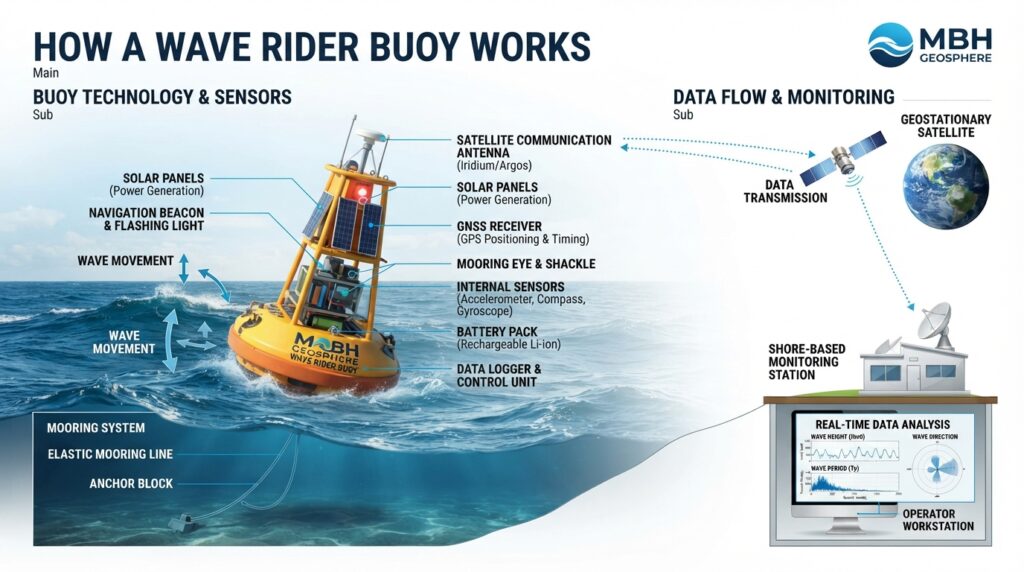
A Wave Rider Buoy is designed to float naturally on the surface of the sea while moving with the waves. As the buoy rises and falls, its internal sensors continuously measure the movement of the water. These sensors record important information such as wave height, wave period, and wave direction. The collected measurements are processed inside the buoy and transmitted to a monitoring station through satellite, radio, or mobile communication networks. Engineers and scientists can view this information in real time, allowing them to monitor changing sea conditions without visiting the buoy.
The system operates continuously throughout the day and night, making it an important tool for offshore projects where weather and wave conditions can change quickly.
Survey Workflow
Before deployment, engineers study the project requirements and select a suitable location where the buoy can safely collect representative wave data. Once the location has been approved, the buoy is transported to the survey area and securely anchored to the seabed. After installation, the onboard sensors begin recording wave motion and environmental conditions. The collected information is processed automatically and transmitted to the monitoring station, where engineers check the quality of the data and use it for project planning, safety assessments, and environmental studies. At regular intervals, the buoy is recovered for inspection, maintenance, and calibration before being redeployed if required.
Main Components of a Wave Rider Buoy
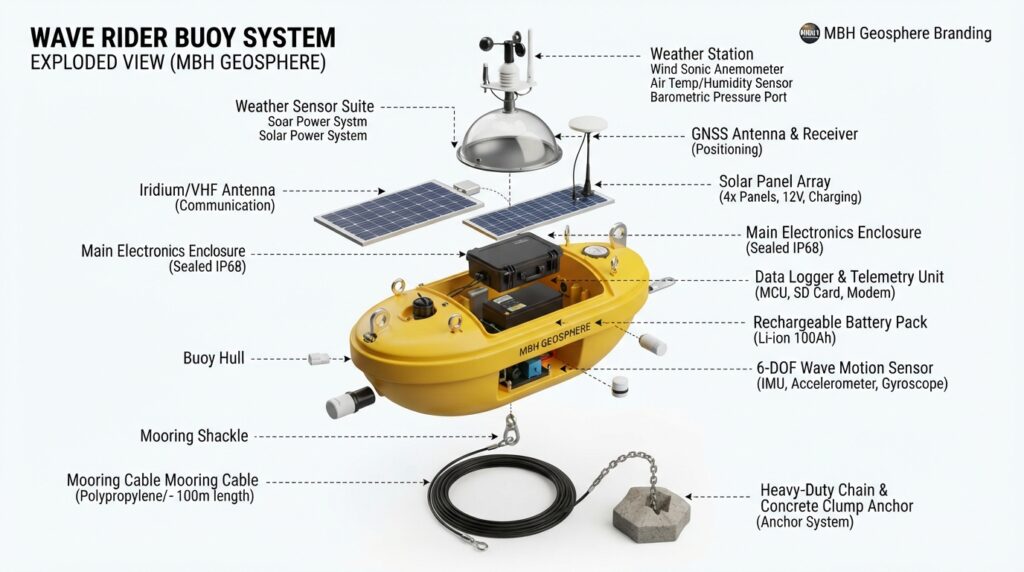
A Wave Rider Buoy is made up of several important components that work together to collect reliable ocean data.
The floating buoy body provides stability and allows the system to move naturally with the waves. It is built from durable materials that can withstand harsh marine environments.
The wave motion sensor is the heart of the system. It measures the vertical and horizontal movement of the buoy to calculate wave height, wave period, and wave direction.
The GNSS receiver records the exact position of the buoy. Accurate positioning is important for monitoring drifting, verifying deployment locations, and supporting data analysis.
The data logger stores all recorded measurements before they are transmitted or downloaded. It ensures that valuable information is not lost even if communication is temporarily interrupted.
The communication system sends data to the control station using satellite communication, radio links, or cellular networks, depending on the project requirements.
The power supply usually consists of rechargeable batteries supported by solar panels. This allows the buoy to operate continuously for long periods without frequent maintenance.
Many modern buoys also include weather sensors that measure wind speed, wind direction, air temperature, atmospheric pressure, and humidity, providing additional environmental information.
Types of Wave Rider Buoys
Different marine projects require different types of Wave Rider Buoys.
A Directional Wave Rider Buoy measures not only wave height and wave period but also the direction from which the waves are travelling. It is commonly used for offshore construction, coastal engineering, and navigation studies.
A Non-Directional Wave Rider Buoy measures wave height and wave period but does not calculate wave direction. It is often used for basic wave monitoring and environmental observations.
A Data Buoy combines wave measurements with weather and oceanographic sensors. In addition to wave information, it can record wind, air temperature, water temperature, and other environmental parameters.
A Metocean Buoy is designed for large offshore projects where engineers require a complete understanding of both meteorological and oceanographic conditions. These buoys are widely used by the offshore oil and gas industry and offshore wind farm developers.
Typical Technical Specifications
| Feature | Typical Value |
|---|---|
| Technology | Ocean Wave Monitoring |
| Platform | Floating Buoy |
| Positioning | GNSS |
| Communication | Satellite, Radio or Cellular |
| Power Source | Battery with Solar Charging |
| Main Measurements | Wave Height, Wave Period, Wave Direction |
| Additional Sensors | Wind, Temperature, Pressure, Humidity |
| Deployment Duration | Several Months to One Year (Project Dependent) |
Why Accurate Wave Data Matters
Accurate wave information helps engineers make better decisions before starting marine operations. Large waves can delay offshore construction, affect dredging activities, and create unsafe conditions for survey vessels. By monitoring wave conditions continuously, project managers can schedule work more efficiently, reduce operational risks, and improve the safety of personnel and equipment.
Wave data is also valuable for long-term coastal studies. Scientists use it to understand seasonal wave patterns, shoreline erosion, and the impact of storms on coastal environments. This information supports the design of ports, breakwaters, offshore platforms, and renewable energy projects.
Applications of a Wave Rider Buoy
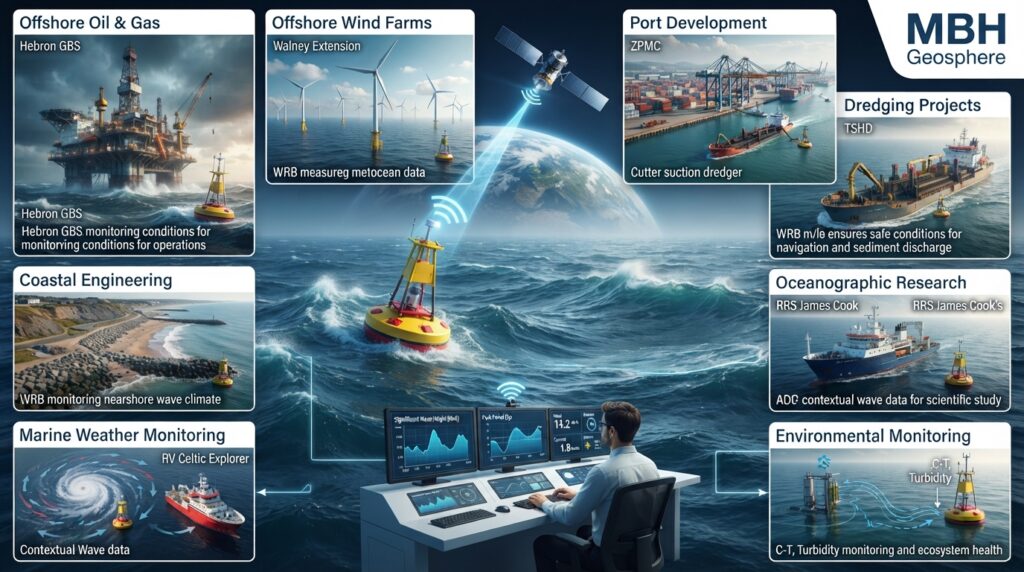
A Wave Rider Buoy is used in many marine industries where accurate wave information is essential. It continuously measures sea conditions and provides reliable data that helps engineers, scientists, and marine operators make informed decisions before and during offshore operations.
In offshore oil and gas projects, Wave Rider Buoys monitor sea conditions around drilling platforms and production facilities. The collected wave data helps engineers decide when it is safe to transport equipment, carry out lifting operations, or perform underwater inspections.
For offshore wind farms, Wave Rider Buoys provide important information during both the planning and operational stages. Engineers study wave conditions before installing turbine foundations and continue monitoring the site to support maintenance activities throughout the life of the project.
During port and harbor development, Wave Rider Buoys help engineers understand local wave conditions before designing breakwaters, navigation channels, and marine structures. Long-term wave records improve the safety and efficiency of port operations.
In dredging projects, wave information helps project managers plan daily work. Rough sea conditions can reduce dredging efficiency and increase operational risks. Continuous monitoring allows work to be scheduled during suitable weather conditions.
For coastal engineering, Wave Rider Buoys provide valuable information about wave energy, shoreline changes, and coastal erosion. Engineers use this data when designing seawalls, groynes, breakwaters, and beach protection projects.
In oceanographic research, scientists study long-term wave patterns to better understand ocean behavior, seasonal changes, and climate impacts. The information collected by Wave Rider Buoys supports research programs around the world.
Wave Rider Buoys also play an important role in marine weather forecasting. Meteorological agencies use real-time wave measurements to improve marine weather reports and provide warnings for ships and offshore industries.
Many countries include Wave Rider Buoys in their tsunami and coastal hazard monitoring systems. Although these buoys are not designed to detect tsunamis directly, their wave data supports broader ocean monitoring networks and helps scientists understand unusual sea conditions.
Advantages of a Wave Rider Buoy
A Wave Rider Buoy provides continuous and accurate wave measurements without requiring people to remain at sea. It operates day and night, even during changing weather conditions, making it a reliable source of marine information.
The system improves offshore safety by helping engineers decide when sea conditions are suitable for construction, maintenance, and survey operations. It also reduces project delays by providing real-time environmental data instead of relying only on weather forecasts.
Modern Wave Rider Buoys consume very little power and can remain deployed for several months using rechargeable batteries supported by solar panels. They also allow remote monitoring, reducing the need for frequent site visits and lowering operational costs.
Limitations of a Wave Rider Buoy
Although a Wave Rider Buoy is highly reliable, it also has some limitations.
Severe storms may damage the buoy or its mooring system if it is not designed for extreme conditions. Marine growth such as algae and barnacles can affect sensor performance if regular maintenance is not carried out.
Communication may occasionally be interrupted because of satellite coverage or equipment faults, although most systems continue recording data internally until communication is restored.
A Wave Rider Buoy measures conditions only at its deployment location. Sea conditions can vary across a large project area, so additional buoys or other monitoring systems may be required for complete coverage.
Popular Wave Rider Buoy Models
Some of the most widely used Wave Rider Buoy models include the Datawell Directional Waverider DWR4, Datawell DWR-G, AXYS WatchKeeper Buoy, Sofar Spotter Buoy, NexSens CB Series Buoy, and OSIL WaveNet Buoy.
Each model is designed for different water depths, deployment durations, and monitoring requirements.
Wave Rider Buoy vs ADCP
| Feature | Wave Rider Buoy | ADCP |
|---|---|---|
| Main Purpose | Measures waves | Measures water current |
| Installation | Floating on the sea surface | Mounted on the seabed or vessel |
| Main Output | Wave height, period and direction | Current speed and current direction |
| Typical Use | Weather and sea state monitoring | Current measurement and flow analysis |
| Survey Type | Oceanographic Survey | Hydrographic Survey |
Wave Rider Buoy vs Tide Gauge
| Feature | Wave Rider Buoy | Tide Gauge |
|---|---|---|
| Measures | Waves | Water level |
| Installation | Floating buoy | Fixed structure |
| Main Output | Wave characteristics | Tidal elevation |
| Best Used For | Offshore wave monitoring | Tide monitoring |
| Real-Time Data | Yes | Yes |
Real-World Example
An engineering company is preparing to install an offshore wind farm. Before construction begins, a Wave Rider Buoy is deployed at the project site for several months. During this period, it records wave height, wave direction, and wave period under different weather conditions.
The collected information helps engineers identify calm working periods, design stronger foundations, and select equipment that can safely operate in local sea conditions. As a result, construction is completed more safely and with fewer weather-related delays.
Why Engineers Use a Wave Rider Buoy
Engineers rely on a Wave Rider Buoy because it provides continuous and accurate information about sea conditions. The data supports better planning, improves offshore safety, reduces operational risks, and helps protect expensive equipment. Long-term wave records also improve the design of marine structures and contribute to scientific research and environmental management.
Related Equipment
A Wave Rider Buoy is often used together with other marine survey equipment such as an Acoustic Doppler Current Profiler (ADCP), Tide Gauge, Multibeam Echo Sounder (MBES), Single Beam Echo Sounder (SBES), Survey Vessel, Uncrewed Surface Vessel (USV), GNSS Receiver, and meteorological sensors. Combining data from these systems provides a more complete understanding of marine conditions.
Frequently Asked Questions
What is a Wave Rider Buoy?
A Wave Rider Buoy is a floating ocean monitoring system that measures wave height, wave period, and wave direction. It collects real-time wave information to support offshore engineering, marine research, weather forecasting, and coastal management.
What is a Wave Rider Buoy used for?
Wave Rider Buoys are used to monitor sea conditions before and during offshore operations. They help engineers, scientists, and marine operators understand wave behavior and make safe operational decisions.
What information does a Wave Rider Buoy measure?
A Wave Rider Buoy mainly measures wave height, wave period, and wave direction. Many modern systems also record wind speed, wind direction, air temperature, atmospheric pressure, water temperature, and other environmental parameters.
Can a Wave Rider Buoy transmit data in real time?
Yes. Most modern Wave Rider Buoys transmit data through satellite, radio, or cellular communication. Engineers can monitor sea conditions from offices or control centers without visiting the buoy.
How long can a Wave Rider Buoy stay at sea?
The deployment period depends on the buoy design and project requirements. Many systems can operate continuously for several months because they use rechargeable batteries supported by solar panels.
What is the difference between a Wave Rider Buoy and an ADCP?
A Wave Rider Buoy measures wave characteristics such as height, direction, and period, while an ADCP measures the speed and direction of water currents below the surface. Both systems are often used together during marine surveys.
Why is wave monitoring important?
Wave monitoring improves offshore safety, supports engineering design, helps schedule marine operations, and provides valuable information for weather forecasting and environmental studies.
Maintenance
A Wave Rider Buoy should be inspected regularly to ensure reliable performance. The buoy body should be cleaned to remove marine growth that may affect sensor accuracy. Solar panels should be kept clean so they can charge the batteries efficiently. Communication antennas, GNSS equipment, and weather sensors should be checked during every maintenance visit. All electrical connections should remain dry and secure, while batteries should be tested and replaced when necessary. Software and firmware should also be updated according to the manufacturer’s recommendations.
Safety Considerations
Before deploying a Wave Rider Buoy, engineers should review the weather forecast and sea conditions. The mooring system must be installed correctly so the buoy remains stable throughout the deployment period. All lifting operations should follow approved safety procedures, and personnel should wear appropriate personal protective equipment. During maintenance, power systems and communication equipment should be handled carefully to prevent damage. Survey data should be backed up regularly to avoid information loss.
Common Challenges
Strong storms and rough sea conditions can place heavy loads on the buoy and its mooring system. Marine growth may reduce sensor performance if cleaning is delayed. Communication interruptions may occur because of weather or satellite coverage, although most buoys continue storing data internally until communication is restored. Battery performance can also decrease over time, making regular inspections important for long-term deployments.
Best Practices
The best results are achieved when the deployment location is carefully selected, the buoy is calibrated before installation, and the collected data is monitored regularly. Engineers should review incoming measurements frequently to identify unusual readings or equipment issues. Preventive maintenance should be carried out according to the manufacturer’s schedule, and all recorded data should be archived for future analysis and reporting.