Trailing Suction Hopper Dredger (TSHD)
A Self-Propelled Dredger for Efficient Marine Dredging
Introduction
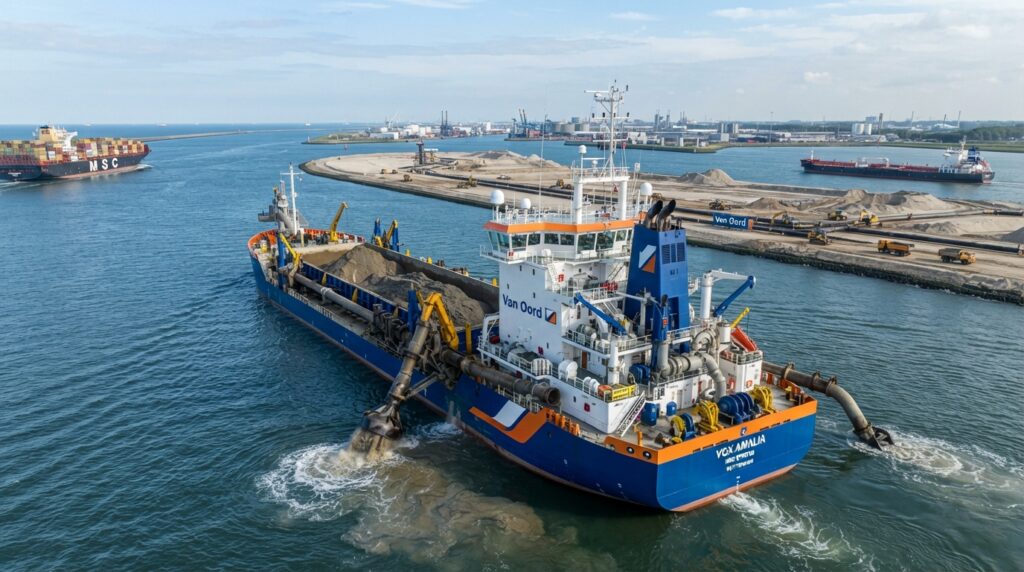
Rivers, ports, harbors, and shipping channels naturally become shallower as sand, silt, and mud settle on the seabed. If this material is not removed regularly, ships may not have enough water depth to navigate safely.
A Trailing Suction Hopper Dredger (TSHD) is one of the most common dredging vessels used to remove loose seabed material. Unlike a Cutter Suction Dredger, a TSHD collects the dredged material inside a large hopper built into the vessel. Once the hopper is full, the dredger sails to a designated disposal or reclamation area and unloads the material.
Because it is self-propelled and does not rely on floating pipelines during normal operations, a TSHD is highly efficient for dredging large areas and working in open water.
Today, TSHDs are widely used by dredging companies, port authorities, offshore contractors, and government organizations around the world.
What is a Trailing Suction Hopper Dredger?
A Trailing Suction Hopper Dredger, commonly known as a TSHD, is a self-propelled dredging vessel that removes loose seabed material using drag heads connected to suction pipes.
As the vessel slowly sails along the dredging area, the drag heads remain in contact with the seabed. Powerful dredge pumps suck sand, silt, mud, and fine gravel into the hopper.
The dredged material remains stored inside the hopper until the vessel reaches the discharge location. Depending on the project requirements, the material can be discharged through bottom doors, pumped ashore through pipelines, or sprayed onto land using a bow connection.
This makes the TSHD one of the most flexible dredging vessels for marine projects.
Why is a Trailing Suction Hopper Dredger Important?
A Trailing Suction Hopper Dredger plays an important role in keeping waterways open and safe for navigation.
Without regular dredging, sediment builds up in ports and navigation channels, reducing water depth and limiting the size of vessels that can enter.
A TSHD removes these deposits efficiently while continuing to move through the dredging area. Since it stores the dredged material inside its own hopper, there is no need for continuous discharge pipelines during normal dredging operations.
Its high mobility makes it especially suitable for large offshore projects, long navigation channels, and coastal maintenance work.
Where is a Trailing Suction Hopper Dredger Used?
Port Maintenance
Ports require regular maintenance dredging to remove accumulated sediment and maintain safe water depths for commercial shipping.
Navigation Channels
Shipping channels gradually become shallower because of natural sedimentation. A TSHD restores the required depth, allowing large ships to navigate safely.
Land Reclamation
A TSHD can transport dredged sand to reclamation sites where it is pumped ashore to create new land for ports, airports, industrial zones, and residential developments.
Coastal Protection
Clean sand collected by a TSHD is often placed on eroding beaches to restore shorelines and protect coastal infrastructure.
Offshore Projects
Before offshore construction begins, TSHDs prepare the seabed by removing loose sediments from work areas.
Harbor Development
During harbor expansion projects, TSHDs deepen approach channels, turning basins, and berthing areas to accommodate larger vessels.
Beach Nourishment
Many coastal protection projects use TSHDs to pump offshore sand onto beaches that have been damaged by erosion.
Environmental Dredging
In some projects, TSHDs remove contaminated sediments under controlled conditions to improve water quality and restore marine environments.
Quick Facts
| Feature | Details |
|---|---|
| Full Name | Trailing Suction Hopper Dredger |
| Short Name | TSHD |
| Type | Self-Propelled Hydraulic Dredger |
| Main Function | Dredges and Stores Material in Hopper |
| Excavation Method | Drag Head and Suction Pipe |
| Material Transport | Internal Hopper |
| Common Material | Sand, Silt, Mud, Fine Gravel |
| Common Users | Dredging Companies, Port Authorities, Marine Contractors |
Did You Know?
Some of the world’s largest Trailing Suction Hopper Dredgers can carry more than 40,000 cubic meters of dredged material in a single trip, making them ideal for large-scale land reclamation and offshore dredging projects.
How Does a Trailing Suction Hopper Dredger Work?
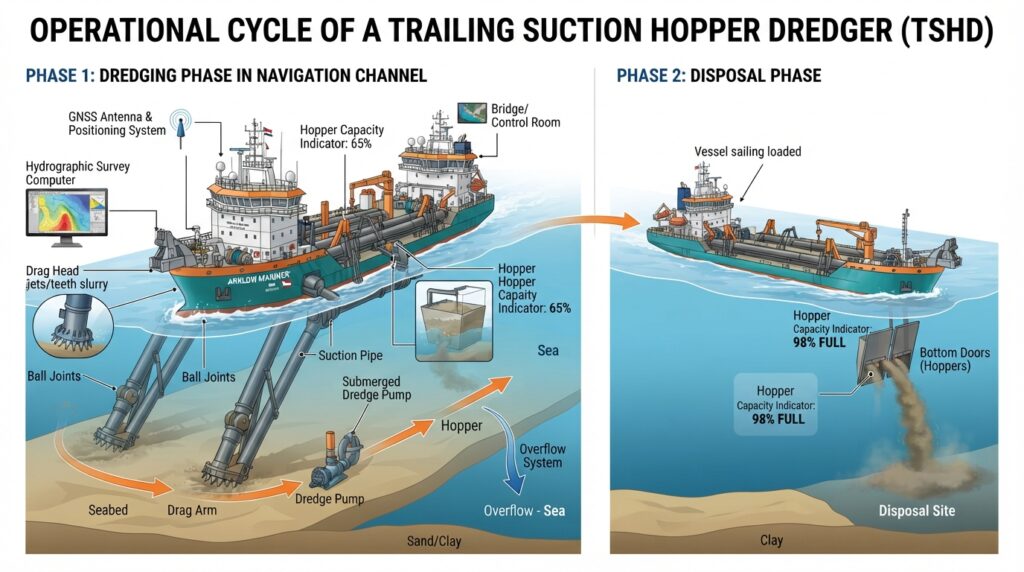
A Trailing Suction Hopper Dredger removes loose material from the seabed while the vessel moves slowly through the dredging area.
The dredging process begins when the vessel reaches the project location. Using GNSS positioning and hydrographic survey software, the operator follows the planned dredging route.
Two suction pipes, called drag arms, are lowered until the drag heads touch the seabed. Powerful dredge pumps create suction and pull a mixture of water and sediment into the vessel.
The dredged material is stored inside a large hopper while excess water flows back into the sea through overflow systems.
When the hopper reaches its maximum capacity, the dredger sails to the discharge location. Depending on the project requirements, the material is released through bottom doors, pumped ashore through pipelines, or sprayed onto land using a bow connection.
After unloading, the vessel returns to the dredging area and repeats the process until the required depth has been achieved.
Dredging Process
Every Trailing Suction Hopper Dredger follows a planned dredging sequence to ensure safe and efficient operations.
The project starts with a hydrographic survey to measure the existing seabed levels.
Engineers prepare the dredging plan and upload the design to the dredging control system.
The vessel sails to the work area and follows the planned dredging route using GNSS positioning.
The drag arms are lowered to the seabed.
The drag heads collect sand, silt, or mud while dredge pumps transport the material into the hopper.
The hopper gradually fills with dredged material while excess water flows out through the overflow system.
Once the hopper is full, the vessel sails to the disposal or reclamation area.
The material is discharged through bottom doors, pumped through pipelines, or delivered using a bow coupling system.
A post-dredge hydrographic survey confirms that the required dredging depth has been achieved.
Main Components of a Trailing Suction Hopper Dredger
Drag Arms
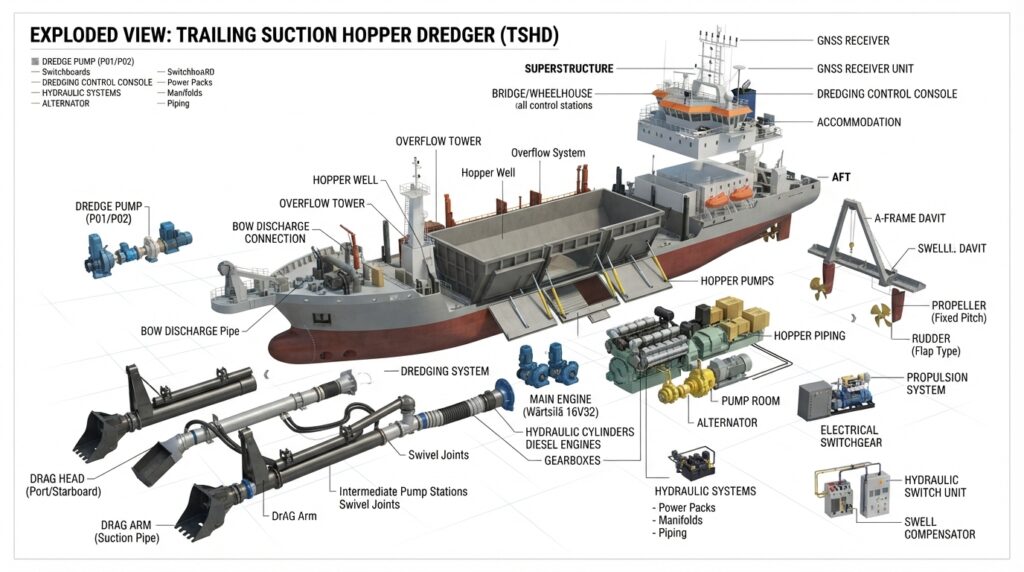
Drag arms are long steel suction pipes located on both sides of the vessel. They are lowered to the seabed to collect dredged material during operation.
Drag Heads
The drag head is attached to the end of each drag arm. It remains in contact with the seabed and controls how sediment enters the suction system. Modern drag heads are designed to reduce environmental impact while maintaining high production.
Dredge Pumps
Powerful centrifugal dredge pumps transport the mixture of water and sediment from the drag heads into the hopper. These pumps are designed to handle large volumes of slurry continuously.
Hopper
The hopper is the large storage compartment inside the vessel. It temporarily stores the dredged material until it reaches the discharge location.
Overflow System
The overflow system allows excess water to leave the hopper while keeping the solid material inside. This increases the amount of sediment that can be carried during each trip.
Bottom Doors
Large hydraulic doors are located beneath the hopper. These doors open when the vessel reaches the disposal area, allowing the dredged material to fall directly onto the seabed.
Bow Connection
Some Trailing Suction Hopper Dredgers include a bow discharge connection. This allows the dredged material to be pumped through floating pipelines directly onto land during reclamation projects.
Propulsion System
Unlike many other dredgers, a TSHD is self-propelled. Powerful engines and propellers allow the vessel to travel independently between the dredging area and the discharge location.
Bridge
The bridge is the control center of the vessel. Operators monitor navigation, dredging operations, hopper capacity, pump performance, and positioning systems from this location.
GNSS Positioning System
High-accuracy GNSS receivers continuously monitor the vessel’s position. This helps operators follow the planned dredging lines and maintain excavation accuracy.
Dredging Control Software
Modern software displays real-time information including vessel position, dredging depth, hopper capacity, production rate, and project progress. Engineers use this data to improve efficiency and maintain quality.
Types of Trailing Suction Hopper Dredgers
Different TSHDs are designed for different project sizes and operating conditions.
Small Trailing Suction Hopper Dredger
Small TSHDs are commonly used for harbor maintenance, marinas, rivers, and small navigation channels where maneuverability is important.
Medium Trailing Suction Hopper Dredger
Medium-sized vessels are suitable for port maintenance, coastal dredging, and regional land reclamation projects.
Large Trailing Suction Hopper Dredger
Large TSHDs are designed for major land reclamation, offshore construction, deep navigation channels, and large-scale capital dredging projects. These vessels can carry tens of thousands of cubic meters of material in a single trip.
Typical Technical Specifications
| Feature | Typical Value |
|---|---|
| Dredger Type | Self-Propelled Hydraulic Dredger |
| Excavation Method | Drag Head and Suction Pipe |
| Material Storage | Internal Hopper |
| Hopper Capacity | 500 m³ to 40,000+ m³ (Model Dependent) |
| Positioning | GNSS / RTK |
| Material | Sand, Silt, Mud, Fine Gravel |
| Power Source | Diesel Engines |
| Discharge Methods | Bottom Doors, Bow Connection, Pipeline |
| Operation | Continuous Sailing Dredging |
Why a Trailing Suction Hopper Dredger is Highly Efficient
A Trailing Suction Hopper Dredger combines dredging, transportation, and disposal into one vessel. Because it stores the dredged material inside its hopper, there is no need for permanent discharge pipelines during normal operations.
Its self-propelled design allows it to travel quickly between the dredging site and the disposal area. This makes it ideal for large maintenance dredging projects, navigation channels, and offshore work where flexibility and mobility are essential.
Applications of a Trailing Suction Hopper Dredger
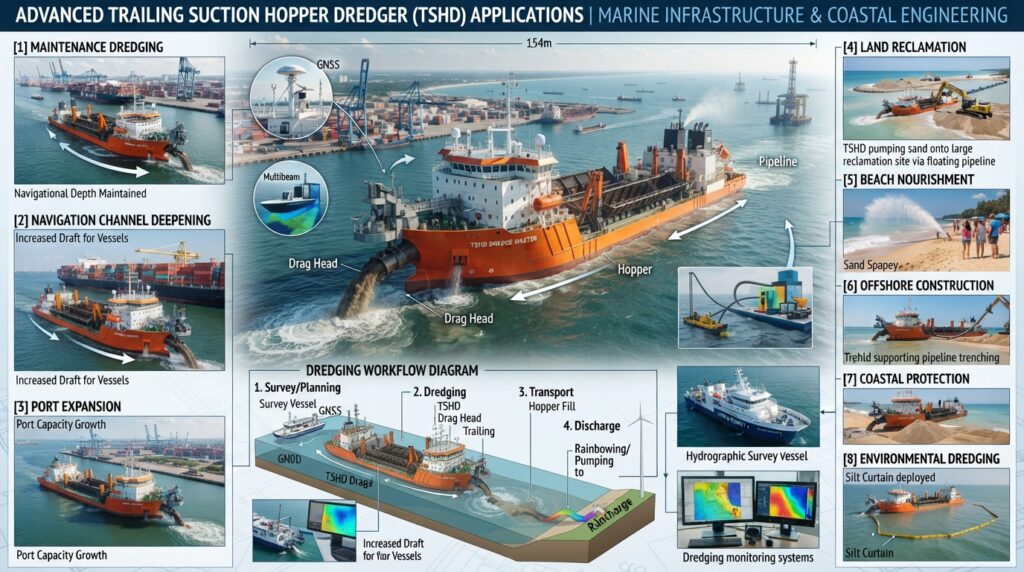
A Trailing Suction Hopper Dredger is one of the most versatile dredging vessels used in the marine industry. Its ability to dredge, transport, and discharge material without external pipelines makes it suitable for a wide range of dredging projects around the world.
Maintenance Dredging
Navigation channels, ports, and harbors naturally collect sand and silt over time. A TSHD removes this material to maintain the required water depth and keep waterways safe for commercial shipping.
Capital Dredging
Before constructing new ports, terminals, or shipping channels, large volumes of seabed material must be removed. A TSHD is commonly used to create new navigation routes and deepen existing waterways.
Land Reclamation
One of the most important applications of a TSHD is land reclamation. The vessel transports dredged sand from offshore borrow areas and pumps it onto land to create new areas for airports, ports, industrial zones, and residential developments.
Beach Nourishment
Many coastlines lose sand because of waves and coastal erosion. A TSHD collects clean offshore sand and places it on beaches to restore the shoreline and protect nearby infrastructure.
Port Expansion
As ships become larger, ports need deeper berths and wider turning basins. A TSHD helps expand port facilities by removing sediment and creating the required water depth.
Offshore Construction
Before offshore structures such as wind farms, oil platforms, and marine terminals are installed, the seabed often requires preparation. A TSHD removes loose sediments to provide a stable foundation for construction.
Coastal Protection
Governments and coastal authorities use TSHDs to strengthen beaches, dunes, and coastal defenses. This helps reduce erosion and protects communities from storm damage.
Environmental Dredging
In some projects, contaminated sediments are carefully removed from rivers, lakes, and coastal waters to improve water quality and restore the natural environment.
Advantages of a Trailing Suction Hopper Dredger
A Trailing Suction Hopper Dredger is self-propelled, allowing it to travel independently between the dredging area and the discharge site without assistance.
The vessel stores dredged material inside its hopper, eliminating the need for continuous floating pipelines during normal dredging operations.
It is highly productive for large maintenance dredging and coastal projects because it can continue sailing while collecting material.
A TSHD performs well in open water where anchored dredgers may face operational challenges.
Modern vessels are equipped with advanced GNSS positioning systems, dredging control software, and automated monitoring systems that improve accuracy and efficiency.
Limitations of a Trailing Suction Hopper Dredger
A TSHD is most effective when dredging loose materials such as sand, silt, and mud. It is not suitable for compact clay or hard rock without additional excavation equipment.
The vessel requires sufficient water depth for safe navigation and operation.
Long transport distances between the dredging area and disposal site may reduce overall production efficiency.
Large TSHDs require significant investment and operating costs, making them more suitable for medium and large-scale projects.
Major Manufacturers
Several international shipbuilders manufacture Trailing Suction Hopper Dredgers for projects around the world.
Leading manufacturers include Royal IHC, Damen Shipyards, Royal Boskalis Westminster, Van Oord, Jan De Nul Group, Keppel Offshore & Marine, VOSTA LMG, and China Merchants Industry Holdings.
These companies design and build TSHDs for maintenance dredging, capital dredging, offshore construction, and land reclamation projects.
Popular Trailing Suction Hopper Dredger Models
Many modern TSHDs are built with different hopper capacities to suit various project requirements.
Popular examples include the Royal IHC Beagle Series, Damen TSHD Series, Boskalis Queen of the Netherlands, Jan De Nul Galileo Galilei, Van Oord Vox Series, and IHC Easydredge Series.
Some of the world’s largest TSHDs can carry more than 40,000 cubic meters of dredged material in a single voyage.
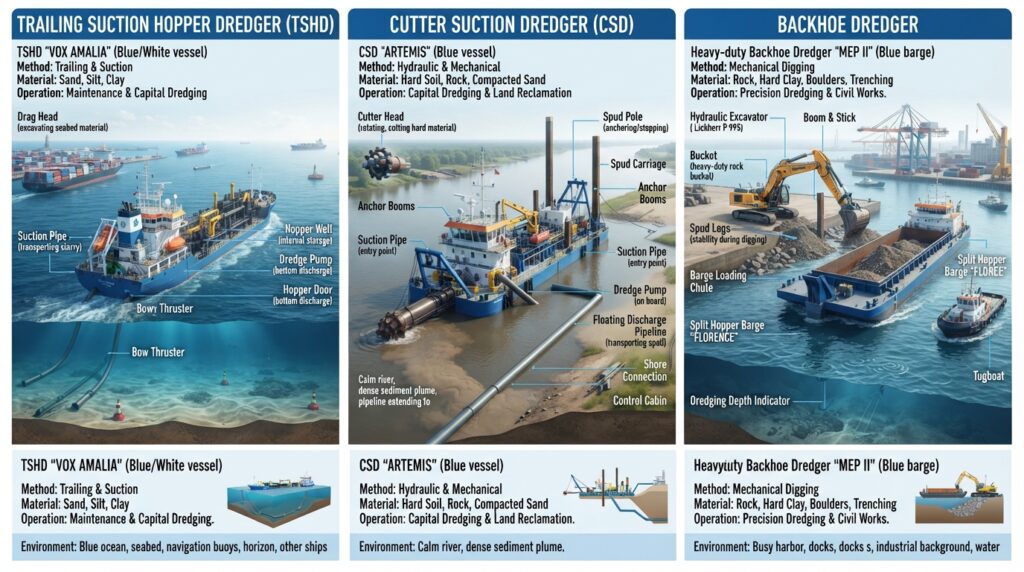
Trailing Suction Hopper Dredger vs Cutter Suction Dredger
| Feature | Trailing Suction Hopper Dredger | Cutter Suction Dredger |
|---|---|---|
| Mobility | Self-Propelled | Anchored |
| Material Storage | Internal Hopper | No Hopper |
| Material Transport | Vessel | Pipeline |
| Best Material | Sand, Silt, Mud | Clay, Gravel, Soft Rock |
| Best Project | Maintenance Dredging | Land Reclamation & Heavy Excavation |
| Open Sea Operation | Excellent | Moderate |
Trailing Suction Hopper Dredger vs Backhoe Dredger
| Feature | Trailing Suction Hopper Dredger | Backhoe Dredger |
|---|---|---|
| Excavation Method | Drag Head | Excavator Bucket |
| Working Style | Continuous Sailing | Stationary |
| Material Storage | Hopper | Barges |
| Production Rate | High | Medium |
| Best For | Large Navigation Channels | Small Harbors and Precise Excavation |
Real-World Example
A major international port plans to deepen its navigation channel so that larger container ships can enter safely.
Hydrographic surveys show that thousands of cubic meters of sand have accumulated over several years. A Trailing Suction Hopper Dredger is selected because it can remove loose sediment while sailing continuously through the channel.
The vessel collects the material inside its hopper and transports it to an approved offshore disposal area. After dredging is completed, a post-dredge hydrographic survey confirms that the channel has reached its required design depth, allowing larger vessels to use the port safely.
Why Engineers Choose a Trailing Suction Hopper Dredger
Engineers select a Trailing Suction Hopper Dredger because it combines dredging, transportation, and disposal into a single self-propelled vessel.
Its ability to work efficiently in open water, transport large volumes of material, and support both maintenance and capital dredging makes it one of the most valuable dredging vessels in the marine industry.
Whether the project involves navigation channel maintenance, beach nourishment, port expansion, offshore construction, or land reclamation, a TSHD provides a reliable and productive dredging solution.
Related Equipment
A Trailing Suction Hopper Dredger is commonly used together with Multibeam Echo Sounder (MBES), Single Beam Echo Sounder (SBES), GNSS Receiver, RTK GPS, Survey Vessel, USV, ADCP, Tide Gauge, Side Scan Sonar, Sub Bottom Profiler, Dredge Monitoring System, and Hydrographic Survey Software to improve dredging accuracy and monitor project progress.
Frequently Asked Questions
What is a Trailing Suction Hopper Dredger (TSHD)?
A Trailing Suction Hopper Dredger is a self-propelled dredging vessel that removes loose seabed material using drag heads and suction pipes. The dredged material is stored inside a large hopper and transported to a disposal or reclamation area.
What is a TSHD used for?
A TSHD is mainly used for maintenance dredging, capital dredging, navigation channel deepening, port expansion, beach nourishment, land reclamation, coastal protection, and offshore construction projects.
How does a Trailing Suction Hopper Dredger work?
The vessel sails slowly while drag heads remain in contact with the seabed. Powerful dredge pumps suck sand, silt, and mud into the hopper. When the hopper is full, the vessel sails to the discharge location and unloads the material before returning to continue dredging.
What materials can a TSHD dredge?
A TSHD is designed for loose materials such as sand, silt, mud, fine gravel, and soft sediments. It is generally not suitable for hard clay or rock without additional excavation equipment.
Can a TSHD work in rough sea conditions?
Yes. Because it is self-propelled and designed for offshore operations, a TSHD performs well in open sea conditions. However, very rough weather may still reduce production and affect safety.
How is a TSHD different from a Cutter Suction Dredger?
A TSHD stores dredged material inside its hopper and transports it to another location. A Cutter Suction Dredger pumps material directly through pipelines while remaining anchored in one working area.
How is the dredged material discharged?
The material can be released through bottom doors, pumped ashore through a bow connection and pipeline, or discharged by rainbowing, where high-pressure water sprays sand onto a reclamation area.
Why is hydrographic surveying important for TSHD projects?
Hydrographic surveys provide accurate seabed information before, during, and after dredging. Engineers use this data to calculate dredging volumes, monitor excavation progress, control dredging depth, and verify project completion.
Maintenance
Regular maintenance helps keep a Trailing Suction Hopper Dredger operating safely and efficiently. Drag heads should be inspected frequently for wear and damage. Suction pipes, dredge pumps, and overflow systems should be checked for blockages, leaks, and excessive abrasion.
The hopper should be cleaned regularly to prevent sediment buildup. Engines, hydraulic systems, propellers, electrical equipment, and winches should be serviced according to the manufacturer’s maintenance schedule.
GNSS receivers, dredging control systems, and hydrographic monitoring software should be calibrated and updated regularly to maintain accurate positioning and production records.
Safety Considerations
Safe dredging operations begin with proper planning and risk assessment. Before starting work, engineers should review weather forecasts, tidal information, vessel traffic, and hydrographic survey data.
Operators should continuously monitor hopper capacity, pump pressure, vessel speed, engine performance, and dredging depth during the operation.
Crew members should wear appropriate personal protective equipment while working on deck. Emergency communication systems, fire protection equipment, navigation lights, and safety alarms should be inspected before every project.
Regular emergency drills help prepare the crew for unexpected situations at sea.
Common Operational Challenges
Strong ocean currents can affect the position of the drag heads and reduce dredging efficiency.
Large rocks or floating debris may damage the drag heads or block the suction system.
Long sailing distances between the dredging site and disposal area can increase project duration.
Very shallow water may limit vessel movement and reduce hopper loading capacity.
Routine inspections, proper planning, and continuous monitoring help reduce these challenges and improve productivity.
Best Operating Practices
Successful TSHD projects begin with an accurate hydrographic survey and a detailed dredging plan.
Operators should follow the planned dredging lines using GNSS positioning and dredging software.
Drag head pressure, hopper loading, and overflow systems should be monitored continuously to maximize production without overloading the vessel.
Regular communication between the vessel crew, survey team, and project engineers helps maintain safe and efficient operations.
A post-dredge hydrographic survey should always be completed to confirm that the required design depth has been achieved.