
Cutter Suction Dredger (CSD)
A Powerful Machine for Removing Soil, Sand, and Rock from Underwater
Introduction
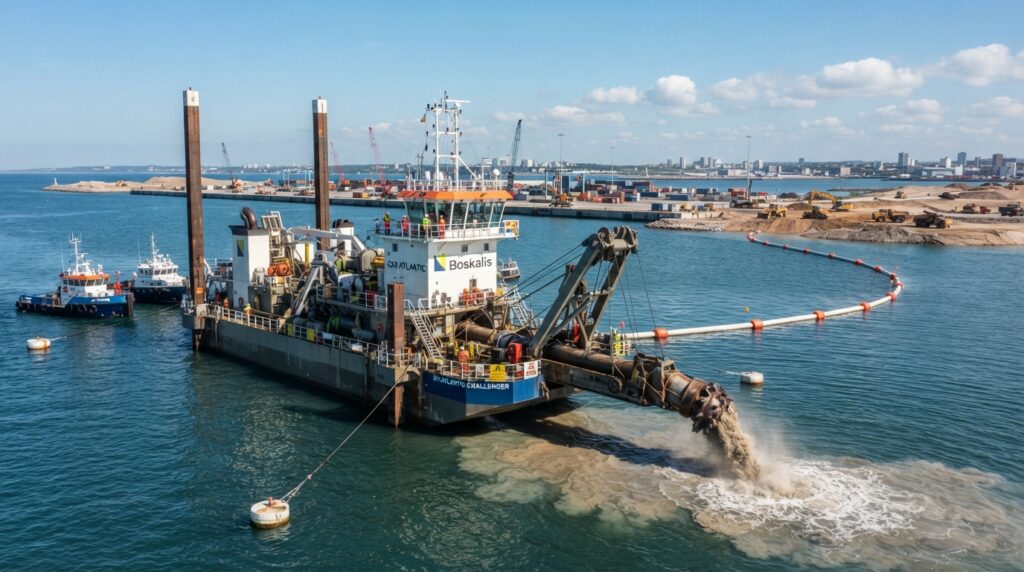
Many rivers, ports, harbors, and coastal areas become shallow over time because sand, mud, and sediment naturally settle on the seabed. If these materials are not removed, ships may have difficulty navigating, construction projects may be delayed, and water flow can be affected.
A Cutter Suction Dredger (CSD) is one of the most widely used dredging vessels for removing underwater material. It is designed to cut hard soil, clay, compact sand, and even soft rock before pumping the material through pipelines to another location.
Because of its high production capacity and continuous operation, a Cutter Suction Dredger is commonly used in land reclamation, port construction, channel deepening, river improvement, and offshore infrastructure projects.
Today, CSDs are used by dredging contractors, marine engineers, port authorities, and government organizations around the world.
What is a Cutter Suction Dredger?
A Cutter Suction Dredger, often called a CSD, is a hydraulic dredging vessel that removes material from the seabed using a rotating cutter head and a powerful dredge pump.
The rotating cutter head breaks up compact soil or rock into smaller particles. At the same time, the dredge pump creates suction that pulls the loosened material into a suction pipe. The dredged material is then transported through floating or land pipelines to a disposal area, reclamation site, or storage location.
Unlike dredgers that collect material inside a hopper, a Cutter Suction Dredger continuously pumps the material through pipelines, making it highly efficient for long-distance transport.
Why is a Cutter Suction Dredger Important?
A Cutter Suction Dredger plays an important role in maintaining safe waterways and supporting marine construction.
Without dredging, ports and navigation channels gradually become shallower, reducing the size of ships that can safely enter. Sediment accumulation can also increase the risk of flooding by reducing river capacity.
A CSD helps restore the required water depth, supports new port construction, creates land reclamation areas, and prepares foundations for bridges, offshore structures, and coastal developments.
Its ability to work in compact soil and continuous pumping operation makes it one of the most productive dredging machines available today.
Where is a Cutter Suction Dredger Used?
Port Construction
Cutter Suction Dredgers are widely used to create and deepen navigation channels, turning basins, and berthing areas. Maintaining the required depth allows larger vessels to operate safely and improves port efficiency.
Land Reclamation
Large quantities of dredged material are pumped to create new land for airports, industrial zones, residential developments, ports, and coastal expansion projects. Many modern cities have been expanded using land reclaimed by Cutter Suction Dredgers.
River Improvement
Rivers naturally accumulate sediment over time. A Cutter Suction Dredger removes this material to improve water flow, increase channel capacity, and reduce the risk of flooding.
Canal Construction
New canals require accurate excavation to achieve the required design depth and width. A CSD provides continuous excavation and pumping, making it ideal for these large-scale projects.
Offshore Construction
Marine construction projects often require seabed preparation before pipelines, offshore wind farms, bridges, and marine terminals can be installed. A Cutter Suction Dredger removes unwanted material and prepares a stable working area.
Mining Projects
Some mining operations use Cutter Suction Dredgers to recover valuable minerals from rivers, lakes, or coastal environments. The dredged material is transported to processing facilities for further separation.
Environmental Restoration
Dredging is also used to remove contaminated sediment, restore lakes and wetlands, and improve water quality in environmentally sensitive areas.
Quick Facts
| Feature | Details |
|---|---|
| Full Name | Cutter Suction Dredger |
| Short Name | CSD |
| Type | Hydraulic Dredger |
| Main Function | Excavates and Pumps Underwater Material |
| Transport Method | Pipeline |
| Excavation Tool | Rotating Cutter Head |
| Material | Sand, Mud, Clay, Gravel, Soft Rock |
| Common Users | Dredging Companies, Port Authorities, Marine Contractors |
Did You Know?
A large Cutter Suction Dredger can move thousands of cubic meters of material every hour, making it one of the most productive dredging machines used in marine engineering projects worldwide.
How Does a Cutter Suction Dredger Work?
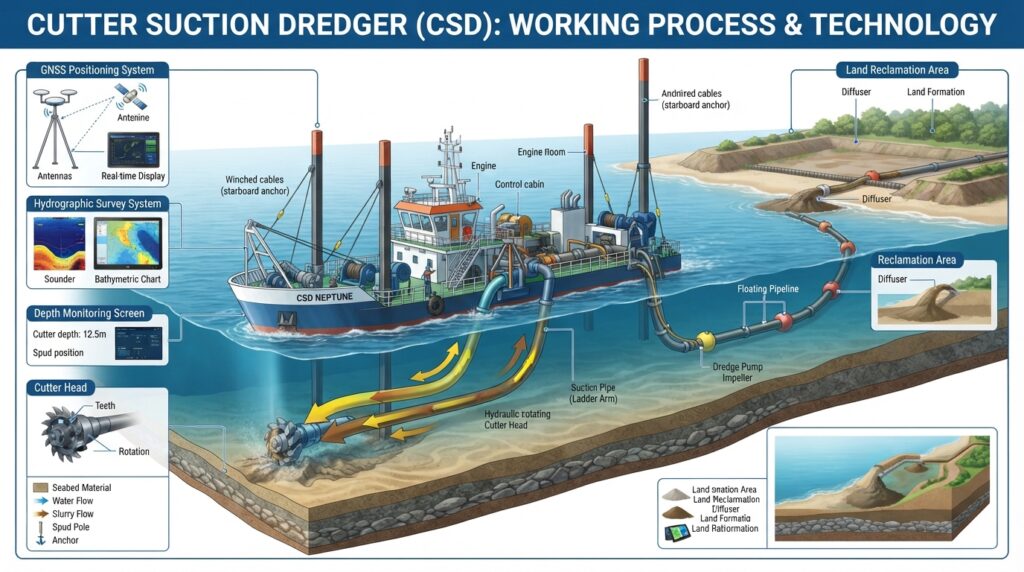
A Cutter Suction Dredger works by cutting the seabed and pumping the loosened material through a pipeline to another location.
The dredging process begins when the dredger is positioned at the survey area using anchors and spud poles. Once the vessel is stable, the cutter head is lowered to the required depth.
The rotating cutter head breaks hard soil, clay, compact sand, gravel, or soft rock into smaller pieces. At the same time, a powerful dredge pump creates suction that pulls the loosened material into the suction pipe.
The dredged material, mixed with water, forms a slurry. This slurry is transported through floating pipelines or land pipelines to a disposal area, land reclamation site, or storage pond.
The dredger continues moving slowly from side to side while cutting the seabed until the required design depth is achieved.
Because the material is pumped continuously, a Cutter Suction Dredger can work for long periods without stopping, making it one of the most productive dredging machines available.
Dredging Process
Every Cutter Suction Dredger follows a simple working process.
The project starts with a hydrographic survey to measure the existing seabed levels.
Engineers prepare the dredging plan and mark the working area using GNSS positioning systems.
The dredger is moved into position and secured using anchors and spud poles.
The cutter head is lowered to the seabed.
The cutter begins rotating and loosens the material.
The dredge pump immediately sucks the material into the suction pipe.
The slurry travels through floating or land pipelines to the discharge location.
Engineers continuously monitor the dredging depth using hydrographic survey equipment to ensure the required design levels are achieved.
After the project is completed, a final hydrographic survey confirms that the dredging work meets the project specifications.
Main Components of a Cutter Suction Dredger
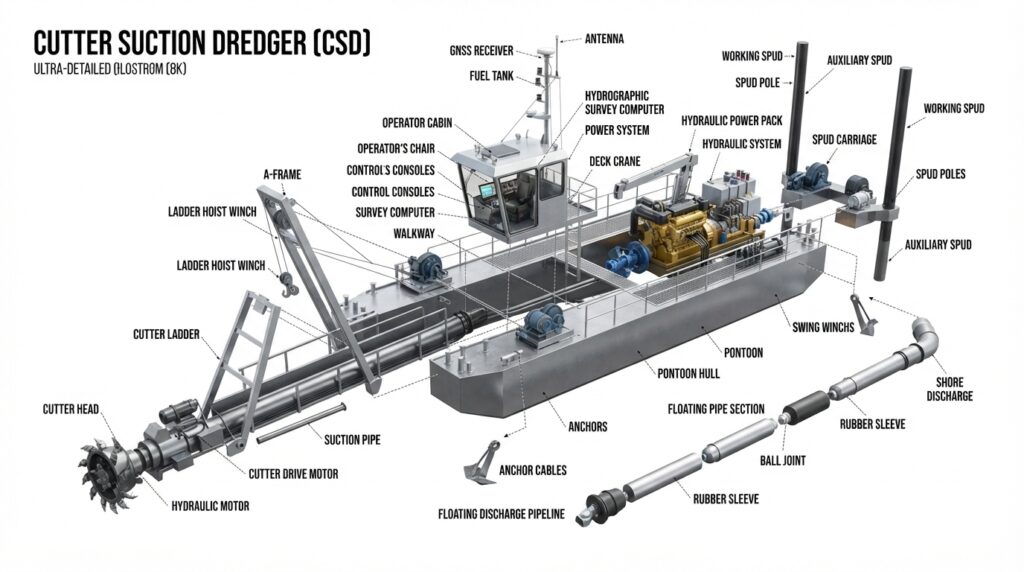
Cutter Head
The cutter head is the most important part of the dredger. It rotates continuously to cut compact soil, clay, sand, gravel, and soft rock into smaller pieces that can be pumped through the pipeline.
Cutter Ladder
The cutter ladder supports the cutter head and suction pipe. It can be raised or lowered to control the dredging depth according to project requirements.
Suction Pipe
The suction pipe carries the dredged material from the cutter head to the dredge pump. It is designed to handle large volumes of slurry during continuous operation.
Dredge Pump
The dredge pump creates powerful suction and transports the slurry through the discharge pipeline. It is one of the most powerful systems on the dredger.
Discharge Pipeline
The discharge pipeline carries the dredged material from the dredger to the disposal area or land reclamation site. Pipelines may be floating on the water surface or installed on land.
Spud Poles
Spud poles are large steel columns that hold the dredger in position during excavation. They act like temporary anchors and allow the dredger to swing from side to side while dredging.
Swing Winches
Swing winches control the movement of the dredger by pulling on the anchor cables. This allows the cutter head to cover the entire dredging area evenly.
Anchors
Anchors keep the dredger stable while working. They help maintain accurate positioning during the excavation process.
Engine Room
The engine room contains the diesel engines or electric power systems that operate the cutter head, pumps, hydraulic systems, and onboard equipment.
Operator Cabin
The operator cabin is the control center of the dredger. Engineers monitor pump pressure, cutter speed, dredging depth, pipeline pressure, engine performance, and GNSS positioning from this location.
GNSS Positioning System
Modern Cutter Suction Dredgers use GNSS receivers to determine their exact position. Accurate positioning ensures that dredging follows the approved design and avoids unnecessary excavation.
Hydrographic Survey Software
Survey software displays the dredger’s position, design depth, and excavation progress in real time. Engineers use this information to monitor production and maintain accuracy throughout the project.
Types of Cutter Suction Dredgers
Different projects require different sizes of Cutter Suction Dredgers.
Small Cutter Suction Dredger
Small CSDs are commonly used for rivers, canals, ponds, reservoirs, and small harbor maintenance projects where working space is limited.
Medium Cutter Suction Dredger
Medium-sized dredgers are suitable for port maintenance, navigation channels, coastal engineering, and medium-scale land reclamation projects.
Large Cutter Suction Dredger
Large CSDs are designed for major infrastructure projects such as deep-water ports, offshore developments, artificial islands, and large land reclamation works. These machines can excavate very hard materials and transport slurry over several kilometers.
Typical Technical Specifications
| Feature | Typical Value |
|---|---|
| Dredger Type | Hydraulic Cutter Suction Dredger |
| Excavation Method | Rotating Cutter Head |
| Material Transport | Pipeline |
| Dredging Depth | Up to 35 m or more (model dependent) |
| Pump Type | Centrifugal Dredge Pump |
| Positioning | GNSS / RTK |
| Power Source | Diesel or Electric |
| Excavated Material | Sand, Mud, Clay, Gravel, Soft Rock |
| Operation | Continuous Dredging |
Why a Cutter Suction Dredger is Highly Efficient
A Cutter Suction Dredger combines excavation and material transport into one continuous process. Unlike some other dredgers that must stop to unload material, a CSD pumps the dredged material directly through pipelines while excavation continues.
This continuous operation increases production, reduces project time, and lowers operating costs. It also allows material to be transported directly to reclamation sites without additional handling.
Applications of a Cutter Suction Dredger
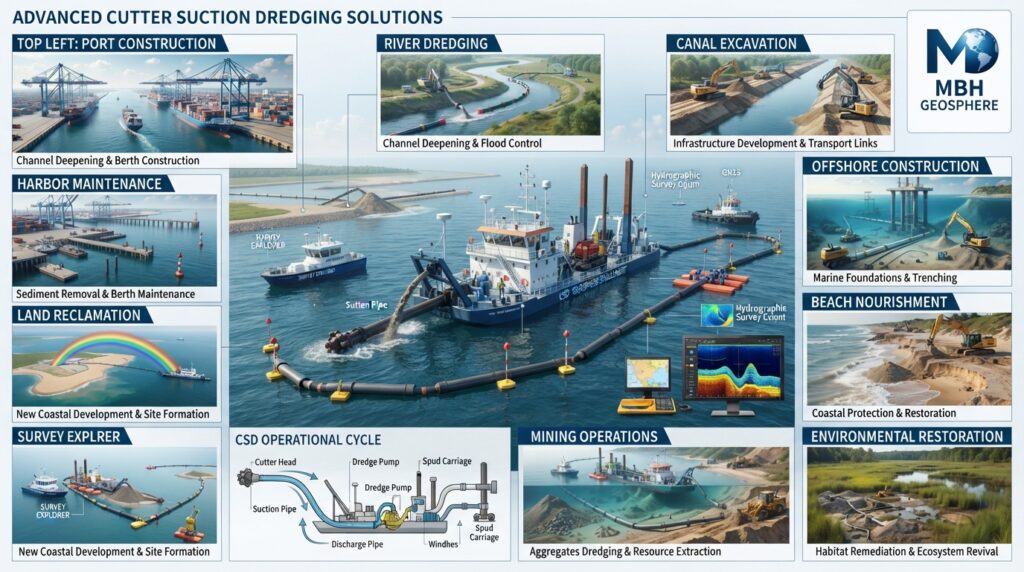
A Cutter Suction Dredger is used in many marine construction and dredging projects because it can excavate large volumes of underwater material quickly and efficiently. It is suitable for both maintenance dredging and new construction projects.
Port Construction
Ports require deep navigation channels and berthing areas for ships. A Cutter Suction Dredger removes sediment and hard soil to create safe water depths for commercial vessels and cargo ships.
Harbor Maintenance
Over time, mud and sand settle in harbors, reducing water depth. A CSD removes this material and keeps the harbor safe for daily marine traffic.
Land Reclamation
One of the most common uses of a Cutter Suction Dredger is land reclamation. The dredged material is pumped through pipelines to create new land for airports, industrial areas, ports, housing developments, and coastal expansion projects.
River Dredging
Rivers naturally collect sediment over time. A Cutter Suction Dredger removes this material to improve water flow, increase channel capacity, and reduce flooding risks.
Canal Construction
New canals require accurate excavation to achieve the required design depth. A CSD provides continuous excavation and pumping, making it ideal for canal construction projects.
Offshore Construction
Before offshore platforms, subsea pipelines, bridges, and wind farms are installed, the seabed often needs preparation. A Cutter Suction Dredger removes unwanted material and creates a stable working surface.
Mining Operations
Some mining companies use Cutter Suction Dredgers to recover sand, gravel, and valuable minerals from rivers, lakes, and coastal areas.
Beach Nourishment
A CSD can pump clean sand from offshore borrow areas to beaches that have been affected by erosion. This helps restore coastlines and protect nearby infrastructure.
Environmental Projects
Environmental agencies use Cutter Suction Dredgers to remove contaminated sediment from rivers, lakes, and harbors as part of water quality improvement and restoration programs.
Advantages of a Cutter Suction Dredger
A Cutter Suction Dredger provides continuous dredging without stopping to unload material, making it highly productive for large projects.
It can excavate compact clay, dense sand, gravel, and even soft rock that many other dredgers cannot remove efficiently.
The dredged material can be transported directly through pipelines over long distances, reducing the need for additional transport equipment.
Modern CSDs use GNSS positioning and hydrographic software, allowing engineers to control dredging depth with high accuracy.
Because the excavation and pumping processes happen at the same time, project completion is often faster and more cost-effective.
Limitations of a Cutter Suction Dredger
A Cutter Suction Dredger normally works while anchored with spud poles and anchor cables, so it cannot move freely like some self-propelled dredgers.
The machine requires floating or land pipelines to transport dredged material, which may increase setup time on some projects.
Strong waves and rough offshore conditions can reduce operating efficiency.
The equipment requires experienced operators and regular maintenance to achieve the best performance.
Major Manufacturers
Many international companies design and manufacture Cutter Suction Dredgers for projects around the world.
Some of the best-known manufacturers include Royal IHC, Damen Shipyards, Ellicott Dredges, VOSTA LMG, IMS Dredges, Qingzhou Julong, Relong Technology, and DSC Dredge.
These companies supply dredgers for port construction, river engineering, offshore projects, mining, and land reclamation.
Popular Cutter Suction Dredger Models
Several Cutter Suction Dredger models are widely used across the dredging industry.
Popular examples include the Damen CSD Series, Royal IHC Beaver Series, Ellicott Series 670, Ellicott Series 870, IMS Model 7012 HP, Julong CSD Series, and Relong RL-CSD Series.
Different models are designed for different dredging depths, production capacities, and project sizes.
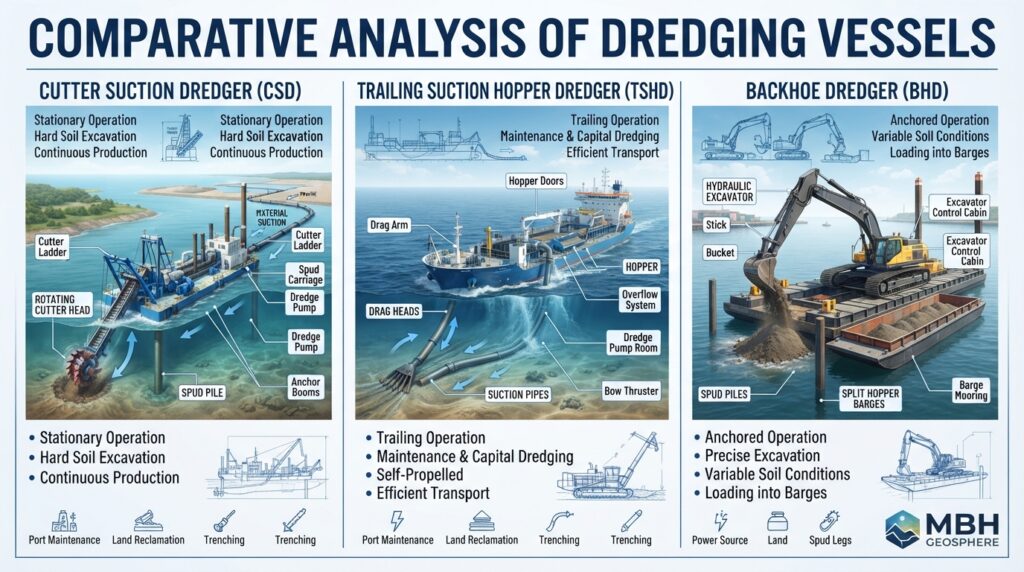
Cutter Suction Dredger vs Trailing Suction Hopper Dredger
| Feature | Cutter Suction Dredger | Trailing Suction Hopper Dredger |
|---|---|---|
| Material Transport | Pipeline | Hopper Storage |
| Excavation | Rotating Cutter Head | Drag Head |
| Mobility | Anchored | Self-Propelled |
| Best Material | Hard Soil, Clay, Soft Rock | Sand and Soft Sediment |
| Land Reclamation | Excellent | Good |
| Offshore Work | Limited | Excellent |
Cutter Suction Dredger vs Backhoe Dredger
| Feature | Cutter Suction Dredger | Backhoe Dredger |
|---|---|---|
| Excavation Method | Hydraulic Cutter | Excavator Bucket |
| Production Rate | High | Medium |
| Material Transport | Pipeline | Barges |
| Best For | Large Projects | Small and Precise Projects |
| Working Area | Open Water | Harbors and Tight Spaces |
Real-World Example
A port authority plans to expand an international container terminal to accommodate larger cargo vessels.
Hydrographic surveys show that the existing navigation channel is too shallow. Engineers deploy a Cutter Suction Dredger to remove compact sand and clay from the seabed. The dredged material is pumped through floating pipelines to create a nearby land reclamation area.
After the dredging work is completed, a post-dredge hydrographic survey confirms that the required design depth has been achieved. The expanded channel allows larger ships to enter the port safely while the reclaimed land provides space for new port facilities.
Why Engineers Choose a Cutter Suction Dredger
Engineers choose a Cutter Suction Dredger because it combines excavation and material transport into one continuous process. It delivers high production rates, accurate dredging depths, and reliable performance on large marine construction projects.
Whether the project involves port expansion, river improvement, land reclamation, offshore construction, or environmental restoration, a Cutter Suction Dredger remains one of the most effective dredging solutions available.
Related Equipment
A Cutter Suction Dredger is commonly used together with Multibeam Echo Sounder (MBES), Single Beam Echo Sounder (SBES), GNSS Receiver, RTK GPS, Survey Vessel, USV, ADCP, Tide Gauge, Side Scan Sonar, Sub Bottom Profiler, Dredge Monitoring System, and Hydrographic Survey Software to ensure safe, accurate, and efficient dredging operations.
Frequently Asked Questions
What is a Cutter Suction Dredger (CSD)?
A Cutter Suction Dredger is a hydraulic dredging vessel that removes underwater material using a rotating cutter head and a powerful dredge pump. The dredged material is transported through pipelines to a disposal area or land reclamation site.
What is a Cutter Suction Dredger used for?
A Cutter Suction Dredger is used for port construction, harbor maintenance, river dredging, land reclamation, canal construction, offshore projects, mining operations, and environmental restoration.
How does a Cutter Suction Dredger work?
The cutter head rotates and breaks up the seabed while the dredge pump sucks the loosened material into the suction pipe. The mixture of water and sediment is then pumped through pipelines to another location.
What materials can a Cutter Suction Dredger dredge?
A Cutter Suction Dredger can dredge mud, sand, silt, clay, gravel, compact soil, and soft rock. The type of cutter head used depends on the ground conditions.
Can a Cutter Suction Dredger work offshore?
Yes. A Cutter Suction Dredger can work offshore, especially in sheltered coastal areas and marine construction projects. However, very rough sea conditions may reduce its efficiency because the dredger normally operates while anchored.
What is the difference between a Cutter Suction Dredger and a Trailing Suction Hopper Dredger?
A Cutter Suction Dredger pumps material directly through pipelines and is ideal for compact soils and land reclamation. A Trailing Suction Hopper Dredger stores dredged material inside a hopper and transports it to the discharge location, making it more suitable for maintenance dredging in open waters.
How deep can a Cutter Suction Dredger dredge?
The maximum dredging depth depends on the dredger model. Small CSDs may dredge around 10–15 meters, while large modern Cutter Suction Dredgers can work at depths of more than 35 meters using specialized equipment.
Why is hydrographic surveying important before dredging?
Hydrographic surveys provide accurate information about the existing seabed. Engineers use this data to calculate dredging volumes, prepare dredging plans, monitor excavation progress, and confirm that the required design depth has been achieved after the project is completed.
Maintenance
Regular maintenance is essential for safe and efficient dredging operations. The cutter head should be inspected frequently for wear and damaged teeth. The dredge pump and suction pipe should be checked for blockages, erosion, and leaks. Hydraulic systems, engines, gearboxes, and winches should be serviced according to the manufacturer’s maintenance schedule.
Floating pipelines should be inspected regularly to ensure that all pipe joints remain secure and leak-free. GNSS positioning equipment and hydrographic monitoring systems should be calibrated periodically to maintain accurate dredging operations.
After every project, the dredger should be cleaned thoroughly, moving parts should be lubricated, and all critical components should be inspected before the next deployment.
Safety Considerations
Safe dredging operations begin with proper project planning. Before starting work, engineers should review hydrographic survey data, weather forecasts, tidal information, and underwater hazards.
The dredger should always be positioned correctly using anchors and spud poles before excavation begins. Operators should continuously monitor cutter head load, pump pressure, engine performance, and pipeline pressure throughout the operation.
All personnel should wear appropriate personal protective equipment, and only trained operators should control the dredging equipment. Emergency stop systems, fire protection equipment, and communication systems should always remain operational.
Common Operational Challenges
Hard rock formations can reduce cutter productivity and increase equipment wear.
Floating debris may block the suction pipe or damage the cutter head.
Very rough sea conditions can reduce dredging accuracy and affect pipeline stability.
Long pumping distances may require additional booster pumps to maintain slurry flow.
Regular inspections and preventive maintenance help reduce downtime and improve production.
Best Operating Practices
Successful dredging projects begin with an accurate hydrographic survey and a well-planned dredging strategy.
Engineers should continuously monitor dredging depth using GNSS positioning and hydrographic survey software. Production data should be reviewed daily to ensure the project remains on schedule.
Floating pipelines should be inspected regularly, and booster pumps should be used when transporting material over long distances.
A post-dredge hydrographic survey should always be completed to verify that the required design depth has been achieved before the project is closed.