
Backhoe Dredger
A Powerful Mechanical Dredger for Accurate Underwater Excavation
Introduction
Many marine construction projects require precise excavation in areas where accuracy is more important than production speed. Harbors, ports, rivers, bridge foundations, and offshore construction sites often contain compact soil, rocks, and other hard materials that cannot be removed efficiently by all dredgers.
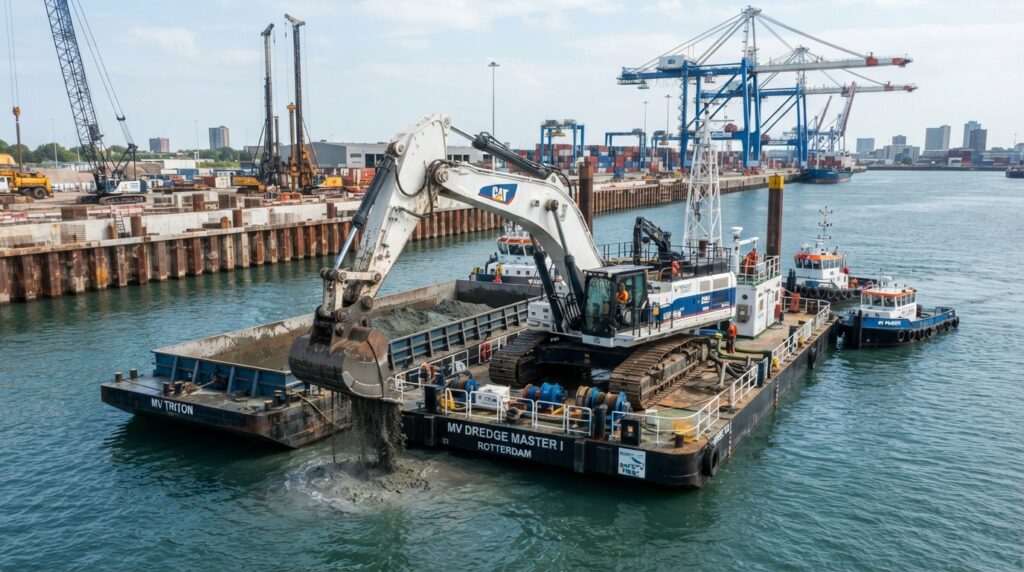
A Backhoe Dredger is a mechanical dredging vessel equipped with a large hydraulic excavator. Instead of using suction pumps, it digs the seabed using a heavy-duty bucket and places the excavated material into barges for transport.
Because it provides excellent digging accuracy and can handle hard materials, a Backhoe Dredger is widely used for port construction, quay wall excavation, bridge foundations, offshore projects, and maintenance dredging.
Today, Backhoe Dredgers are used by dredging contractors, marine engineers, port authorities, and offshore construction companies around the world.
What is a Backhoe Dredger?
A Backhoe Dredger is a floating platform or pontoon fitted with a hydraulic excavator that excavates underwater material using a bucket.
The excavator digs into the seabed, lifts the material, and places it directly into transport barges positioned alongside the dredger.
Unlike hydraulic dredgers that pump material through pipelines or store it in a hopper, a Backhoe Dredger removes material one bucket at a time. This makes it highly suitable for projects requiring controlled and accurate excavation.
It is commonly used where underwater obstacles, hard soil, compact clay, gravel, or rock need to be removed safely.
Why is a Backhoe Dredger Important?
A Backhoe Dredger allows engineers to perform precise underwater excavation in areas where other dredgers may not be practical.
Its powerful excavator can remove compact materials while minimizing disturbance to nearby structures such as quay walls, bridge piers, pipelines, and offshore foundations.
Because the operator has direct control over every bucket movement, the dredger can achieve accurate excavation depths and clean working areas.
This level of precision makes Backhoe Dredgers an important part of modern marine construction projects.
Where is a Backhoe Dredger Used?
Harbor Construction
Backhoe Dredgers excavate berths, turning basins, and harbor areas where high accuracy is required near existing structures.
Port Expansion
During port development projects, they remove compact soil and rock to create deeper berths for larger vessels.
Bridge Construction
Bridge foundations often require underwater excavation around piles and piers. A Backhoe Dredger performs this work safely and accurately.
Quay Wall Construction
The dredger prepares the seabed before new quay walls, jetties, and marine terminals are built.
Offshore Construction
Backhoe Dredgers are used to prepare foundations for offshore platforms, subsea pipelines, and wind farms by removing unwanted seabed material.
River Dredging
They remove accumulated sediment, debris, rocks, and compact soil from rivers to improve navigation and water flow.
Rock Excavation
Heavy-duty buckets allow Backhoe Dredgers to excavate compact clay, gravel, boulders, and weathered rock that hydraulic dredgers may struggle to remove.
Environmental Projects
Backhoe Dredgers are often selected for environmental dredging because they can remove contaminated sediment with minimal disturbance to surrounding water.
Quick Facts
| Feature | Details |
|---|---|
| Full Name | Backhoe Dredger |
| Type | Mechanical Dredger |
| Excavation Method | Hydraulic Excavator Bucket |
| Material Transport | Barges |
| Main Function | Accurate Underwater Excavation |
| Best Materials | Clay, Gravel, Rock, Compact Soil |
| Operation | Stationary |
| Common Users | Marine Contractors, Port Authorities, Dredging Companies |
Did You Know?
Modern Backhoe Dredgers can use buckets with capacities of up to 40 cubic meters, allowing them to excavate large volumes of hard material while maintaining excellent accuracy.
How Does a Backhoe Dredger Work?
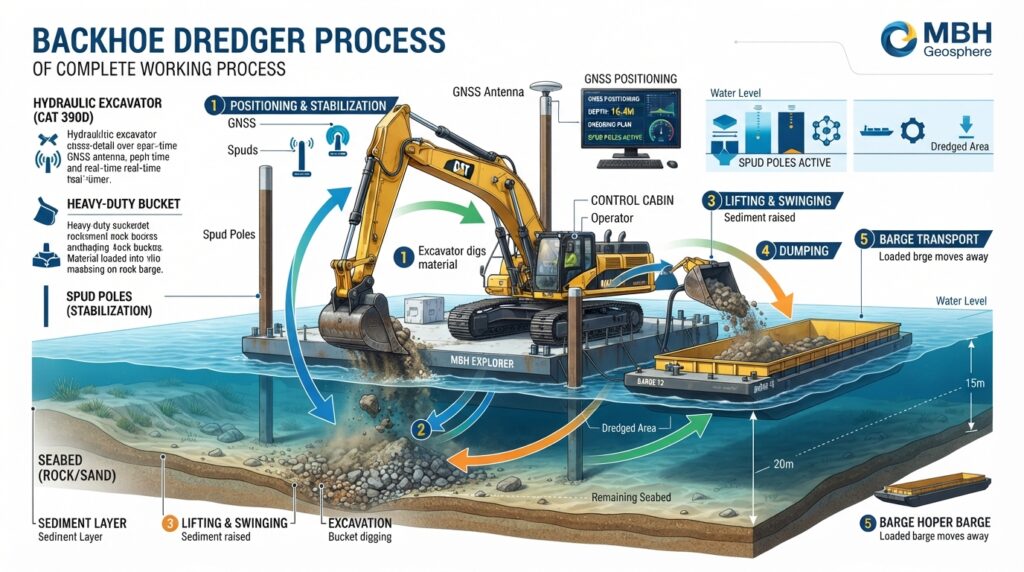
A Backhoe Dredger works by digging underwater material using a hydraulic excavator mounted on a floating pontoon or barge.
Before dredging begins, the dredger is positioned at the work area using spud poles or anchors to keep it stable. Engineers use GNSS positioning and hydrographic survey data to ensure the dredger is located accurately.
The excavator lowers its bucket to the seabed and digs into the soil, clay, gravel, or rock. The bucket is then lifted above the water and swung over a transport barge positioned beside the dredger.
The excavated material is released into the barge, which carries it to the disposal area or reclamation site.
This digging cycle continues until the required excavation depth is achieved. Because the operator controls every bucket movement, a Backhoe Dredger provides excellent excavation accuracy, especially around existing marine structures.
Dredging Process
Every Backhoe Dredger project follows a planned excavation sequence.
The project begins with a hydrographic survey to measure the existing seabed and calculate the required dredging volume.
Engineers prepare the dredging plan and upload the design into the positioning system.
The dredger is moved to the work location and secured using spud poles or anchors.
The hydraulic excavator lowers the bucket to the seabed and begins excavation.
The bucket lifts the excavated material and places it into a transport barge.
The barge carries the material to the approved disposal or reclamation area.
The dredger continues excavating until the required design level is reached.
A final hydrographic survey is completed to verify that the dredging work meets the project specifications.
Main Components of a Backhoe Dredger
Hydraulic Excavator
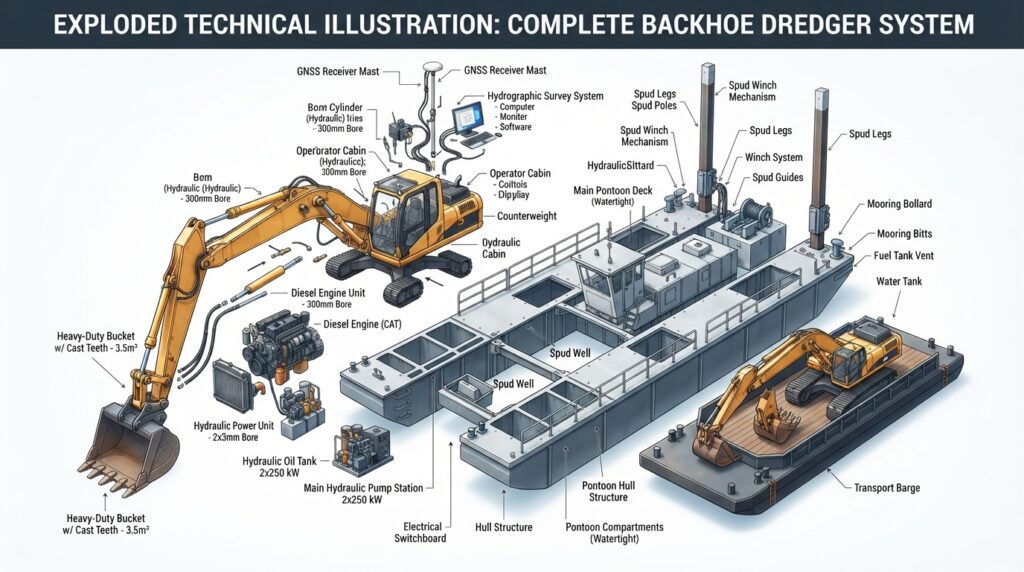
The hydraulic excavator is the main working machine. It provides the power needed to dig, lift, and load underwater material into transport barges.
Excavator Bucket
The bucket cuts into the seabed and collects material during each digging cycle. Different bucket types are available depending on whether the material is mud, clay, gravel, or rock.
Boom
The boom supports the excavator arm and provides the reach needed to excavate underwater material at different depths.
Arm
The arm connects the boom to the bucket and controls the digging movement. It allows the operator to position the bucket accurately during excavation.
Floating Pontoon
The excavator is mounted on a heavy-duty floating pontoon or barge that provides a stable working platform during dredging operations.
Spud Poles
Large steel spud poles are lowered into the seabed to hold the dredger firmly in position while excavation takes place.
Hydraulic System
The hydraulic system powers the boom, arm, bucket, and other moving parts of the excavator. It provides smooth and controlled digging operations.
Operator Cabin
The operator controls the excavator from the cabin while monitoring bucket position, excavation depth, and machine performance.
GNSS Positioning System
Modern Backhoe Dredgers use GNSS receivers to determine the exact position of the dredger and monitor excavation accuracy throughout the project.
Hydrographic Survey Software
Survey software displays real-time dredging information, including vessel position, excavation depth, design levels, and project progress. Engineers use this information to ensure accurate dredging.
Transport Barges
Transport barges receive the excavated material from the Backhoe Dredger and carry it to the disposal site, reclamation area, or processing facility.
Types of Backhoe Dredgers
Different Backhoe Dredgers are designed for different project sizes and excavation conditions.
Small Backhoe Dredger
Small Backhoe Dredgers are commonly used for rivers, marinas, canals, and small harbor maintenance projects where space is limited.
Medium Backhoe Dredger
Medium-sized dredgers are suitable for port maintenance, bridge construction, quay wall excavation, and coastal engineering projects.
Large Backhoe Dredger
Large Backhoe Dredgers are designed for major marine construction projects, deep harbor excavations, offshore developments, and heavy rock removal operations.
Typical Technical Specifications
| Feature | Typical Value |
|---|---|
| Dredger Type | Mechanical Dredger |
| Excavation Method | Hydraulic Excavator Bucket |
| Material Transport | Barges |
| Positioning | GNSS / RTK |
| Dredging Depth | Up to 25 m or more (Model Dependent) |
| Power Source | Diesel Engine |
| Best Material | Mud, Clay, Gravel, Rock |
| Operation | Stationary |
Why a Backhoe Dredger is Highly Efficient
A Backhoe Dredger offers excellent excavation accuracy, making it the preferred choice for projects where precise digging is required.
Unlike hydraulic dredgers that remove material continuously, a Backhoe Dredger gives the operator complete control over every excavation cycle. This makes it ideal for working near quay walls, bridge piers, pipelines, and other underwater structures.
Its powerful hydraulic excavator can also handle hard soil, compact clay, gravel, and rock that may be difficult for suction dredgers to remove.
Frequently Asked Questions
What is a Backhoe Dredger?
A Backhoe Dredger is a mechanical dredging vessel fitted with a hydraulic excavator. It removes underwater material by digging with a bucket and loading the material into transport barges.
What is a Backhoe Dredger used for?
A Backhoe Dredger is used for port construction, harbor maintenance, bridge foundations, quay wall construction, offshore projects, river dredging, rock excavation, and environmental dredging where accurate excavation is required.
How does a Backhoe Dredger work?
The dredger is positioned using spud poles or anchors. The hydraulic excavator digs the seabed with its bucket, lifts the material, and loads it into barges. The barges then transport the material to a disposal or reclamation site.
What materials can a Backhoe Dredger excavate?
A Backhoe Dredger can excavate mud, silt, sand, clay, gravel, boulders, weathered rock, and compact soil. The bucket type is selected according to the ground conditions.
Can a Backhoe Dredger remove rock?
Yes. A Backhoe Dredger is one of the best dredging machines for removing compact soil, gravel, and weathered rock. Heavy-duty buckets and powerful hydraulic systems allow it to excavate materials that are difficult for suction dredgers.
What is the difference between a Backhoe Dredger and a Cutter Suction Dredger?
A Backhoe Dredger excavates material using a hydraulic bucket and loads it into barges, making it ideal for precise excavation. A Cutter Suction Dredger uses a rotating cutter head and pumps material through pipelines, making it better for high-production dredging.
Why is a Backhoe Dredger used near marine structures?
Because the operator controls every bucket movement, the dredger can work safely around quay walls, bridge piers, jetties, pipelines, and other underwater structures with minimal disturbance.
Why is hydrographic surveying important before backhoe dredging?
Hydrographic surveys provide accurate seabed information before excavation begins. Engineers use this data to calculate dredging volumes, define excavation limits, monitor progress, and confirm that the required design depth has been achieved.
Maintenance
Regular maintenance is essential to keep a Backhoe Dredger operating safely and efficiently. The excavator bucket should be inspected for wear, cracks, and damaged teeth before every shift. Hydraulic cylinders, hoses, and pumps should be checked for leaks and proper operation.
The boom, arm, swing mechanism, and undercarriage should be lubricated according to the manufacturer’s maintenance schedule. Diesel engines, electrical systems, and hydraulic power units should be serviced regularly to reduce unexpected breakdowns.
GNSS receivers, hydrographic survey software, and positioning systems should be calibrated frequently to maintain excavation accuracy. After each project, the dredger should be cleaned thoroughly, and all moving parts should be inspected before the next deployment.
Safety Considerations
Safe dredging starts with careful planning and a detailed site assessment. Engineers should review hydrographic survey data, weather conditions, tidal information, and nearby underwater utilities before excavation begins.
The dredger should always be secured using spud poles or anchors before operating the excavator. Operators should monitor bucket loads, hydraulic pressure, excavation depth, and machine stability throughout the project.
Crew members should wear appropriate personal protective equipment, including safety helmets, life jackets, gloves, and safety boots. Emergency stop systems, fire protection equipment, communication devices, and navigation lights should be inspected before every operation.
Common Operational Challenges
Hard rock formations can increase bucket wear and reduce production rates.
Strong currents may affect barge positioning during loading operations.
Large underwater debris can slow excavation and damage the bucket.
Limited working space around bridges and quay walls requires careful planning and experienced operators.
Regular equipment inspections, accurate positioning, and continuous monitoring help reduce downtime and improve project efficiency.
Best Operating Practices
Every successful Backhoe Dredger project begins with a detailed hydrographic survey and a well-prepared dredging plan.
Operators should use high-accuracy GNSS positioning to follow the excavation design. Engineers should monitor dredging depth continuously and compare excavation progress with the project drawings.
Transport barges should be positioned correctly to reduce loading time and improve production efficiency. Daily inspections of the excavator, hydraulic system, and bucket help prevent equipment failures.
After the excavation is complete, a post-dredge hydrographic survey should verify that the required design depth and excavation limits have been achieved.