
3D Crane System
Discover How Modern 3D Crane Systems Lift with Precision and Safety
The 3D Crane System combines powerful lifting equipment with advanced positioning technology to perform safe and accurate lifting operations. This section explains how modern cranes work, their main components, different types, and how 3D guidance systems improve lifting accuracy.
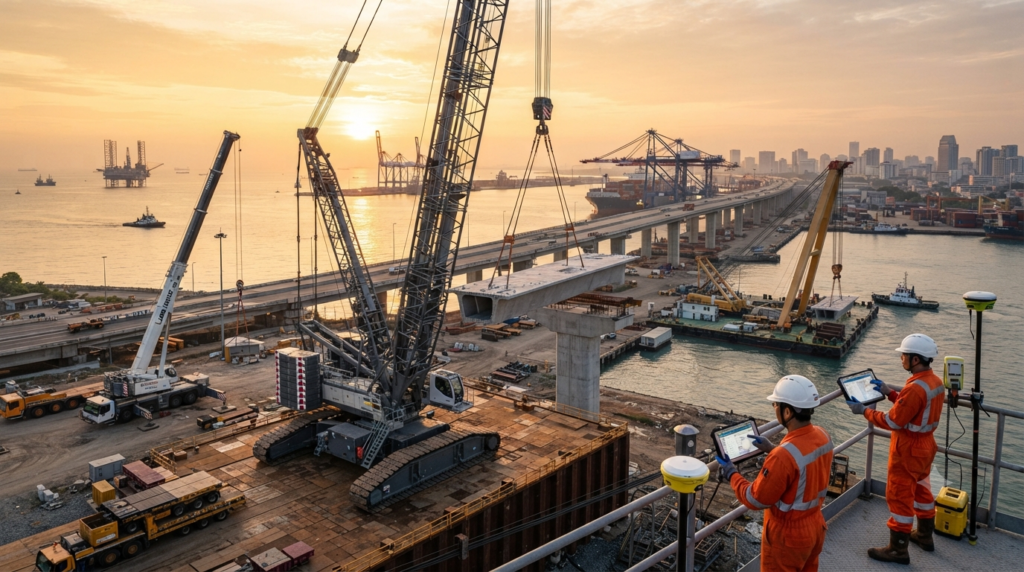
Introduction
Cranes are among the most important machines used in construction and heavy engineering projects. They are designed to lift, move, and place heavy materials that cannot be handled by manual labour or smaller machines.
Today, cranes are used to build bridges, high-rise buildings, ports, offshore platforms, power plants, wind farms, and industrial facilities.
Modern cranes are equipped with advanced hydraulic systems, electronic sensors, GNSS positioning, load monitoring systems, and 3D crane guidance technology. These systems help operators lift heavy loads safely, improve accuracy, and reduce the risk of accidents.
What is a 3D Crane System?
A 3D Crane System is a combination of mechanical, hydraulic, electrical, and digital technologies that help a crane perform lifting operations with greater accuracy.
Unlike traditional cranes that rely mainly on operator experience, a 3D crane system provides real-time information about the crane’s position, boom angle, hook location, lifting height, load weight, working radius, and surrounding obstacles.
This information helps operators complete lifting tasks more safely and efficiently.
Why is a 3D Crane System Important?
Lifting heavy objects requires careful planning and accurate control.
Even a small mistake can damage equipment, delay a project, or create a serious safety risk.
A 3D Crane System gives the operator real-time guidance, helping them position loads correctly, avoid obstacles, and work within the crane’s safe lifting limits. It also improves productivity by reducing repeated adjustments and unnecessary lifting movements.
Main Parts of a 3D Crane System
A modern 3D crane system consists of several important components working together.
These include:
- Diesel Engine or Electric Power System
- Hydraulic Pumps
- Hydraulic Cylinders
- Boom
- Jib
- Hook Block
- Wire Rope
- Winch System
- Slewing System
- Counterweight
- Outriggers (where applicable)
- Operator Cabin
- Touchscreen Control Display
- GNSS Antennas
- 3D Crane Guidance System
- Boom Angle Sensors
- Load Moment Indicator (LMI)
- Load Cells
- Wind Speed Sensor
- Cameras
- Electrical Control System
Each component helps the crane lift loads safely, accurately, and efficiently.
Types of Crane Systems
Different projects require different crane designs.
This section covers:
- Crawler Crane
- Mobile Crane
- Tower Crane
- Floating Crane
- Rough Terrain Crane
- All Terrain Crane
- Truck Mounted Crane
- Harbour Crane
- Offshore Crane
- Telescopic Crane
Each crane is designed for specific lifting conditions and project requirements.
Where are 3D Crane Systems Used?
3D crane systems are widely used in:
- Building Construction
- Bridge Construction
- Port Development
- Offshore Construction
- Shipyards
- Wind Farm Installation
- Oil and Gas Projects
- Industrial Plants
- Power Stations
- Mining Projects
- Heavy Equipment Installation
- Marine Construction
- Infrastructure Development
They are essential wherever heavy lifting must be completed safely and accurately.
What You Will Learn in This Category
In this section, you will learn how different cranes work, their main components, lifting principles, safety systems, machine guidance technology, operating procedures, and the leading manufacturers used around the world.
Each guide is written in simple language so that students, engineers, crane operators, and beginners can easily understand the technology.
Who Should Read This Section?
This category is useful for:
- Civil Engineering Students
- Construction Engineers
- Mechanical Engineers
- Marine Engineers
- Survey Engineers
- Crane Operators
- Site Supervisors
- Project Managers
- Heavy Lift Engineers
- Anyone interested in lifting equipment and crane technology
Conclusion
The 3D Crane System combines powerful lifting equipment with modern digital technology to improve safety, accuracy, and efficiency. By using sensors, GNSS positioning, load monitoring, and real-time guidance, modern cranes can complete complex lifting operations with greater confidence. Understanding how these systems work helps engineers and operators carry out lifting projects safely and successfully.