
How to Set Up a Total Station
Set Up Your Total Station for Accurate Survey Measurements
A Total Station must be set up correctly before starting any survey. A proper setup helps improve accuracy and reduces measurement errors. This guide explains the complete setup process in simple steps that are easy for beginners to understand.
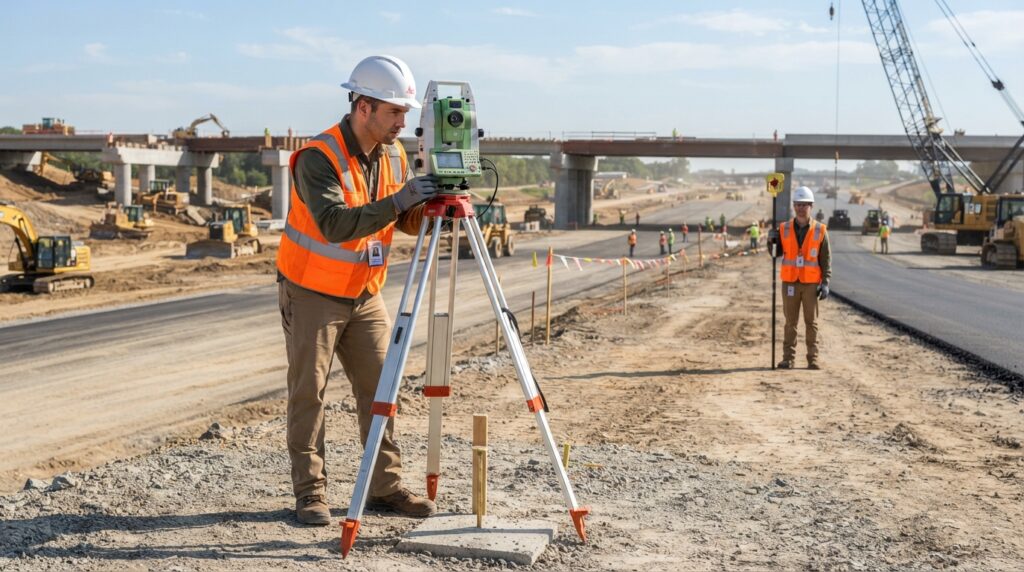
Introduction
A Total Station is a precision surveying instrument. Even a small setup mistake can affect the survey results. Before measuring any point, the instrument must be correctly positioned, centered, and leveled over the survey point.
Following the correct setup procedure helps you collect reliable and accurate data in the field.
Equipment Required
Before starting the survey, make sure you have the following equipment:
- Total Station
- Heavy-Duty Tripod
- Tribrach
- Prism Pole
- Survey Prism
- Field Controller (if required)
- Fully Charged Battery
- Measuring Tape
- Field Book
Step 1 – Select the Survey Point
Choose the control point where the Total Station will be installed.
Make sure the ground is firm and stable. Avoid placing the instrument on loose soil or where heavy machinery may cause vibrations.
Step 2 – Set Up the Tripod
Open the tripod legs and place them over the survey point.
Adjust the height so the telescope is comfortable to use while standing.
Press each tripod leg firmly into the ground to prevent movement.
Step 3 – Mount the Total Station
Attach the Total Station securely to the tripod using the tribrach.
Check that the instrument is firmly locked before continuing.
Step 4 – Center the Instrument
Use the optical plummet or laser plummet to position the Total Station exactly over the survey point.
Adjust the tripod legs slightly until the center mark is directly above the ground point.
This step is very important because incorrect centering will affect all measurements.
Step 5 – Level the Instrument
Use the leveling screws to center the circular bubble.
After that, use the electronic level displayed on the screen for fine adjustment.
Rotate the instrument and check that the bubble remains centered in every direction.
Step 6 – Turn On the Instrument
Switch on the Total Station and allow it to complete the startup process.
Check the battery level before beginning the survey.
Step 7 – Create or Open a Survey Project
Create a new project or open an existing one.
Enter the correct coordinate system, units, and project information.
This ensures that all measured points are stored correctly.
Step 8 – Set the Instrument Height
Measure the height from the survey point to the center of the Total Station.
Enter this value into the instrument.
Accurate instrument height is important for correct elevation calculations.
Step 9 – Set Up the Prism
Mount the prism on the prism pole.
Measure the prism height from the ground to the center of the prism.
Enter the correct prism height into the Total Station.
Step 10 – Take a Backsight
Aim the telescope at a known reference point or backsight point.
Measure the point and confirm the correct direction.
This establishes the orientation of the survey.
Step 11 – Check the Setup
Before starting the survey, measure a known control point.
Compare the measured coordinates with the known coordinates.
If they match within the required tolerance, the setup is correct and you can begin the survey.
Common Mistakes to Avoid
Many survey errors happen because of simple mistakes.
Always make sure the instrument is centered correctly, the bubble is level, the instrument and prism heights are entered correctly, and the prism is held vertically.
Also check that the correct survey project and coordinate system are selected before measuring any points.
Best Practices
Keep the tripod stable throughout the survey.
Clean the instrument regularly and protect it from dust and rain.
Check the battery before starting work.
Save your survey data frequently.
Have the Total Station calibrated according to the manufacturer’s recommendations.
Conclusion
A correctly set up Total Station provides accurate and reliable survey measurements. By following these simple steps, surveyors can reduce errors, improve efficiency, and collect high-quality data for construction and engineering projects.
Related Articles
- What is a Total Station?
- Leading Total Station Models and Brands
- What is a Survey Prism?
- What is a Control Point?
- What is a Traverse Survey?