
Types of Excavator Systems
Explore the Different Types of Excavator Systems
Excavators are available in different sizes and designs to perform specific engineering tasks. This guide explains the most common types of excavator systems and where each one is used.
Introduction
Not every excavation project is the same.
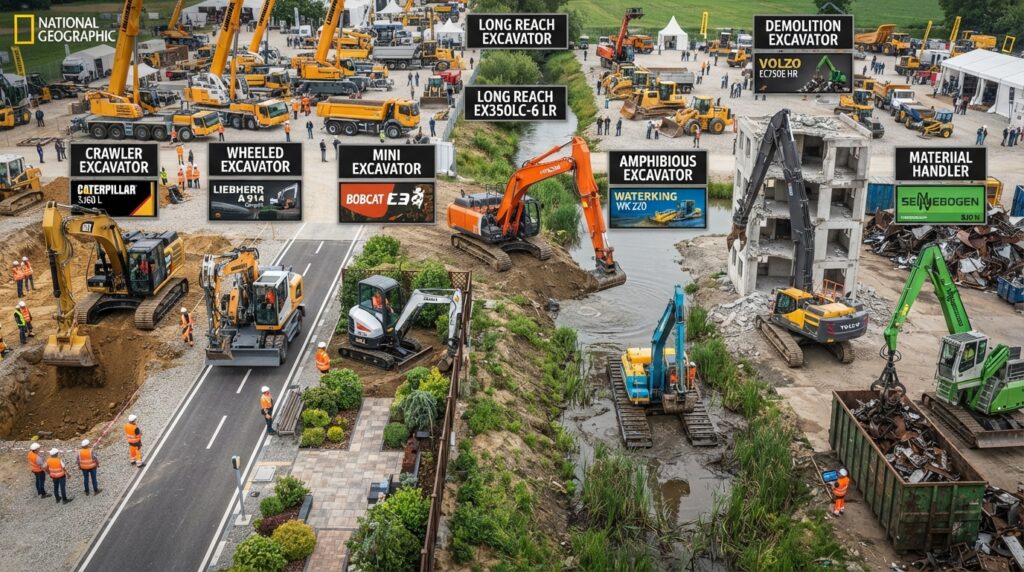
Some projects require deep digging, while others need long reach, heavy lifting, demolition, or work in soft ground. Because of these different requirements, manufacturers have developed several types of excavator systems.
Choosing the right excavator improves productivity, reduces operating costs, and helps complete projects safely and efficiently.
Crawler Excavator
A crawler excavator moves on steel or rubber tracks instead of wheels.
The tracks provide excellent stability and allow the machine to work on soft, muddy, rocky, and uneven ground.
Crawler excavators are the most commonly used excavators in construction, mining, road projects, and dredging.
Common Applications
- Building Construction
- Road Construction
- Mining
- Quarry Operations
- Land Reclamation
- River Dredging
Wheeled Excavator
A wheeled excavator travels on rubber tyres, allowing it to move quickly between different work locations.
It is commonly used in cities where machines frequently travel on paved roads.
Common Applications
- Urban Construction
- Road Maintenance
- Utility Installation
- Municipal Projects
- Small Civil Engineering Works
Mini Excavator
A mini excavator is a compact machine designed for work in narrow or restricted areas.
Despite its small size, it provides excellent digging performance for light construction projects.
Common Applications
- Landscaping
- Residential Construction
- Garden Projects
- Utility Repairs
- Small Foundation Work
Long Reach Excavator
A long reach excavator has an extended boom and arm that allow it to reach much farther than a standard excavator.
It is widely used where the machine cannot move close to the work area.
Common Applications
- River Dredging
- Canal Cleaning
- Slope Protection
- Lake Excavation
- Deep Excavation
Amphibious Excavator
An amphibious excavator is specially designed to work in wetlands, marshes, swamps, rivers, and shallow water.
Its wide floating pontoons reduce ground pressure and improve stability on soft surfaces.
Common Applications
- Wetland Restoration
- River Maintenance
- Swamp Construction
- Shallow Water Dredging
- Environmental Projects
Demolition Excavator
A demolition excavator is equipped with a reinforced long boom and heavy demolition attachments.
It is used to safely demolish tall buildings and industrial structures.
Common Applications
- Building Demolition
- Factory Demolition
- Bridge Removal
- Industrial Site Clearance
Material Handler
A material handler is designed to lift, sort, and move materials instead of digging.
It usually has a long boom fitted with a hydraulic grapple or magnet.
Common Applications
- Scrap Yards
- Recycling Plants
- Ports
- Timber Yards
- Waste Management
Suction Excavator
A suction excavator removes loose soil using powerful vacuum technology instead of a digging bucket.
It is ideal for excavation around underground utilities where damage must be avoided.
Common Applications
- Utility Maintenance
- Cable Installation
- Gas Pipelines
- Water Pipelines
- Sensitive Excavation
How to Choose the Right Excavator
The best excavator depends on your project requirements.
For general construction, a crawler excavator is usually the best choice.
For city projects, a wheeled excavator provides better mobility.
For rivers and canals, a long reach excavator is more suitable.
For wetlands and marshes, an amphibious excavator offers better stability.
For demolition projects, choose a demolition excavator with the correct attachment.
Always consider digging depth, lifting capacity, ground conditions, attachment compatibility, fuel efficiency, maintenance costs, and operator safety before selecting an excavator.
Conclusion
Excavator systems are available in many different types to meet the needs of modern engineering projects. Each type is designed for a specific working environment and application. Understanding the differences between excavator systems helps engineers, contractors, and operators select the right machine for safe, efficient, and productive operations.