Content Review Process
How We Create and Review Our Educational Content
Why This Process Matters
At MBH Geosphere, we believe that educational content should be accurate, practical, and easy to understand.
Before an article is published, it goes through a structured review process. This helps us organize information clearly, improve readability, and reduce mistakes.
Our goal is to provide content that readers can trust and use for learning.
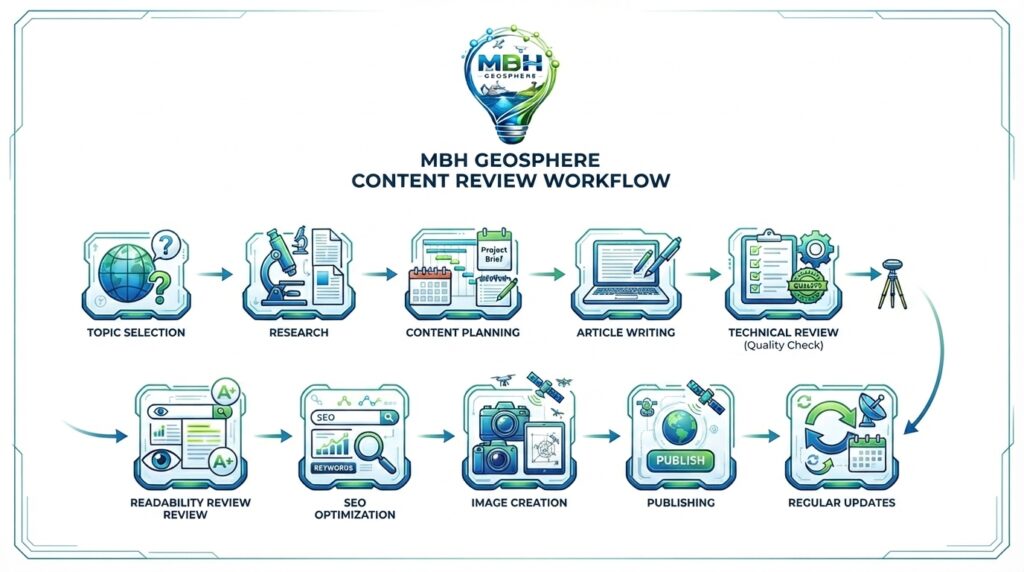
Step 1 – Topic Selection
Every article begins with selecting a useful topic.
We focus on subjects that are important for students, surveyors, engineers, researchers, and professionals working in survey engineering.
Topics are chosen based on educational value, industry relevance, and common questions asked by learners.
Step 2 – Research
After selecting a topic, we collect information from reliable engineering sources.
Our research may include engineering textbooks, technical publications, manufacturer documentation, educational resources, accepted industry practices, and recognized engineering standards where appropriate.
The purpose of this research is to build a strong technical foundation before writing begins.
Step 3 – Content Planning
Before writing, we prepare a clear structure for the article.
This usually includes an introduction, explanation of the technology, working principle, main components, applications, advantages, limitations, frequently asked questions, safety considerations, maintenance information, and related topics.
A structured layout makes learning easier.
Step 4 – Writing
Every article is written in original language specifically for MBH Geosphere.
We avoid unnecessary technical jargon whenever possible and explain engineering concepts using simple English.
Our goal is to make technical information understandable without losing accuracy.
Step 5 – Technical Review
Once the first draft is completed, the article is reviewed for technical accuracy.
We check engineering terms, equipment names, workflow descriptions, and practical explanations to make sure they are correct and consistent throughout the article.
Step 6 – Readability Review
After the technical review, we improve the readability of the article.
Long sentences are simplified, headings are organized, and explanations are adjusted so readers can understand the topic more easily.
We want every article to be useful for both beginners and experienced professionals.
Step 7 – SEO Optimization
Before publishing, the article is optimized for search engines.
This includes writing a clear page title, creating a helpful meta description, organizing headings correctly, optimizing images, adding descriptive alt text, and connecting the article with related pages through internal links.
Our focus is on helping readers find useful information, not simply adding keywords.
Step 8 – Image Preparation
Many engineering topics are easier to understand with diagrams and illustrations.
Whenever possible, we create original educational graphics, technical illustrations, workflow diagrams, comparison charts, and AI-generated educational visuals to support the written content.
Images are optimized for website performance and accessibility.
Step 9 – Publishing
After the article has been reviewed and optimized, it is published on MBH Geosphere.
Each published article becomes part of our growing engineering knowledge library and is connected with related topics to improve the learning experience.
Step 10 – Regular Updates
Engineering technology changes over time.
When new survey equipment, software, standards, or best practices become available, we review existing articles and update them when necessary.
This helps keep our content useful and relevant.
Reader Feedback
We value feedback from our readers.
If someone identifies an error, suggests an improvement, or asks for additional information, we review the feedback carefully and update the content when appropriate.
Reader feedback helps us continue improving MBH Geosphere.
Our Quality Principles
Every article published on MBH Geosphere is guided by a few simple principles.
Accuracy is always more important than speed.
Clarity is more important than complexity.
Education is more important than promotion.
Our goal is to help readers understand survey engineering through practical, reliable, and easy-to-read content.
Our Commitment
The Content Review Process is part of our long-term commitment to building a trusted engineering knowledge platform.
As MBH Geosphere continues to grow, we will continue improving our review process, expanding our educational resources, and updating our content to reflect changes in the engineering industry.
Contact Us
If you notice information that needs correction or would like to suggest a new topic, we welcome your feedback.
Your suggestions help us improve the quality of MBH Geosphere for everyone